Saturday 18th of April 2026

Nairobi, Kenya

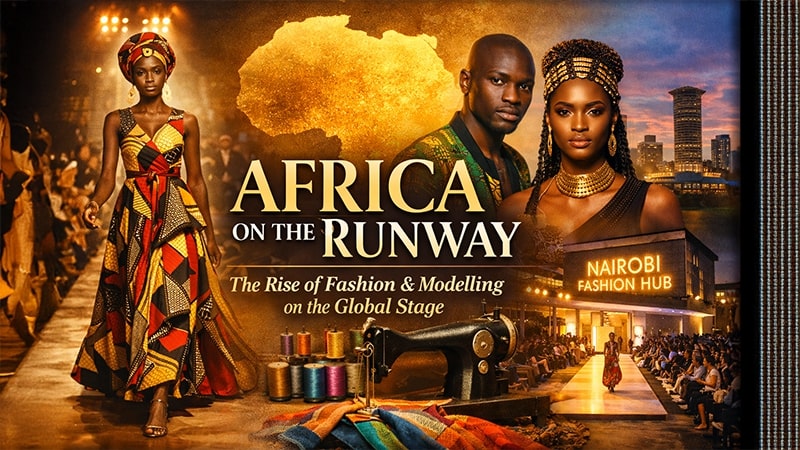
Africa on the Runway: How Fashion and Modelling Are Rewriting the Continent’s Story


Africa on the Runway: How Fashion and Modeling Are Rewriting the Continent’s Story.

Africa’s fashion and modeling industries are no longer whispers in the wings of the global style conversation. They are a chorus loud, inventive, and insistently original, pulling the continent’s textiles, stories, and faces onto international runways, into glossy editorials, and onto e-commerce storefronts. That rise is not accidental: it’s a product of grassroots creativity, entrepreneurial grit, strategic partnerships, and a growing recognition from international buyers and media that African fashion is not a niche but a market and cultural force. Yet the lift-off comes with persistent friction, structural, financial, and logistical, that the industry is learning to overcome in real time.

The landscape: creative abundance, structural scarcity.

From Lagos to Johannesburg and Nairobi to Dakar, designers are mining local crafts, indigenous textiles, and contemporary sensibilities to produce work that reads modern and memorably African. The continent’s apparel and footwear sector is sizeable and growing: recent industry analyses describe a multi-billion-dollar market driven by a young, urbanizing population hungry for styles that speak to identity and aspiration. At the same time, major gaps remain limited capital flowing into creative businesses, weak local supply chains, high costs of quality raw materials, and underdeveloped intellectual-property protections that make scaling risky for designers. These are not cosmetic issues; they shape whether a designer can move from a market stall to sustainable factory runs and from seasonal shows to year-round international distribution. (Euromonitor)

Models, agencies, and representation: progress and persistent gatekeepers.

The modelling side has made visible strides. A new generation of African faces, not merely tokenized but celebrated for their variety and cultural specificity, has appeared on major magazine covers and in advertising campaigns. Publications and runways have started to reflect a broader beauty code, from British Vogue’s landmark Africa-focused features to boutique agencies exporting talent overseas. Yet pipelines are uneven. There are still too few professional agencies with scouting, training, and welfare systems that match international standards, and many aspiring models lack access to education on contracts, health, and financial planning. Where models and agencies collaborate with reputable fashion weeks and hubs, the speed and quality of career development rise. (British Vogue)

The twin engines: local markets and foreign support.

Growth is being fuelled by two complementary currents. First, robust local demand: middle-class growth, the rise of luxury boutiques across African capitals, and digital platforms are expanding domestic consumption. Second, strategic foreign interest from global retailers in cultural institutions that open distribution channels and funding pipelines. International prizes, retail partnerships, and editorial coverage have helped put designers on global maps and provided practical capital and mentorship. Still, dependence on foreign grants or one-off placements is risky; sustainable scale requires stronger domestic investment, better trade policy, and predictable financing instruments for creative SMEs. (Vogue)

Private sector, individuals, and corporate sponsorship: the new patrons of style.

Where governments have been slow to act, individual entrepreneurs and corporations are stepping in. High-net-worth patrons, local retailers, hair and beauty brands, and multinational sponsors are underwriting runway shows, pop-ups, and incubators. These contributions are catalytic: they offer marketing reach, seed capital, and platform visibility. Corporate sponsorships, when thoughtfully structured, can professionalize events and link designers to logistics, export know-how, and retail distribution. But sponsorships must be strategic and long-term: short promotional spends boost visibility but don’t replace investments in production capacity, digital infrastructure, and skills development.

Nairobi Fashion Hub: a case study in market-making

In Nairobi, one organisation exemplifies how a local initiative can alter industry dynamics. Nairobi Fashion Hub (NFH) began as a digital platform and has since developed into a multifaceted ecosystem builder: promoting designers, staging showcases, profiling models and fashion professionals, and creating networking opportunities across East Africa. By amplifying local talent and connecting creators to commercial and editorial channels, NFH helps convert creative capital into economic capital. Its programming, from runway events to training and editorial features, addresses a key industry bottleneck: visibility. For many Kenyan designers and models, platforms like NFH are the bridge between local recognition and regional or global opportunity. (NFH – African Fashion)

What’s changing the rules of the game

Several converging trends are reshaping possibilities:

  • Digitization: E-commerce, social media, and digital lookbooks let designers sell globally without traditional wholesale deals. The pandemic accelerated virtual showcases and direct-to-consumer models. (Vogue)
  • Sustainability and craft revival: A pivot toward regenerative materials, circular fashion, and elevated craft narratives gives African brands a competitive edge in conscious luxury markets.
  • Pan-African collaboration: Fashion weeks and platforms are increasingly pan-African, pooling designers and buyers across borders to build scale. Lagos Fashion Week, for example, has emerged as a major node linking local talent to sponsors and international buyers, a model that other hubs emulate. (Vogue)

The obstacles that won’t vanish overnight

For all the momentum, friction points remain stubborn:

  • Financing: Creative businesses are often high-risk to conventional lenders; alternatives like creative funds, impact investors, and blended finance are still nascent across the continent. (UNESCO)
  • Manufacturing and sourcing: Without integrated supply chains (from spinning yarns to dye houses to finishing facilities), designers face long lead times and quality variability that deters large buyers.
  • Skills and standards: Technical training in pattern cutting, grading, manufacturing management, and modelling professionalism is unevenly distributed. Bridging that gap requires structured vocational programs and private-public partnerships.
  • Market access costs: Trade tariffs, logistics, and export paperwork add layers of cost that make international expansion expensive and slow.

Practical wins: what accelerates success

A set of practical interventions has proven effective in markets that have moved faster:

  1. Incubation + Market Access: Hubs that combine business training with buyer introductions (like NFH’s programming) shorten the runway to commercial deals. (NFH – African Fashion)
  2. Sponsorships with capacity building: Corporate funding tied to supply-chain investments, training, and production support builds durable capacity instead of one-off events.
  3. Regional trade facilitation: Lowering intra-African trade frictions helps brands scale across borders before taking on far-flung export markets.
  4. Investment vehicles for creatives: Dedicated fashion funds, blended finance, and grant-to-equity structures reduce early-stage risk and help brands professionalize.

The human story that matters

At the heart of every statistic are designers, models, tailors, textile workers, and entrepreneurs turning ideas into livelihoods. For them, fashion is not mere glamour; it is jobs, cultural preservation, and new career pathways. Initiatives that respect that human dimension, offering fair pay, worker protections, and sustainable growth, will create an industry that is both stylish and just.

Looking forward: from creative bursts to a durable industry.

Africa has the ingredients for a globally resonant fashion ecosystem: raw creativity, rich textile heritages, a hungry consumer base, and an increasingly connected diaspora market. To turn that potential into long-term impact requires patient capital, smarter public policy, and more hubs that combine visibility with commercial scaffolding. Organisations like Nairobi Fashion Hub are doing the hard, unglamorous work of shaping markets: cataloguing talent, staging consistent platforms, and building the networks that turn runway applause into export contracts.

If stakeholders, designers, models, funders, governments, and media double down on infrastructure and skills while protecting creative agency, Africa will not just contribute to global fashion: it will help redefine the industry’s aesthetics, ethics, and economy. The continent’s next decade in fashion is not a matter of if but how fast and how sustainably it chooses to run.


Sources & further reading: UNESCO’s report on the African fashion sector (trends and challenges); market analysis on apparel in sub-Saharan Africa; Vogue coverage of African fashion and Lagos Fashion Week; Nairobi Fashion Hub’s platform and programming. (UNESCO)

Content courtesy of NFH Digital Team
Meet the Top 20 Finalists Competing at Future Face Africa’s Grand Finale

After a thorough rigorous vetting process, 20 models have been selected as finalists to compete at Future Face Africa‘s grand finale, which takes place at Eko Hotels & Suites on Sunday, the 30th of January 2022.

This maiden competition proves to be a remarkable one as models from eight African countries plus thousands of digital applications worldwide compete for a chance to win the title of Africa’s next future face. Two winners will emerge from the 20 finalists. They will each receive a two-year international modeling contract with a top international modeling agency, as well as a cash prize of five thousand dollars.

https://www.instagram.com/p/CZPUec0qPP6/?utm_source=ig_embed

The FFA project is spearheaded by none other than Elizabeth Isiorho, a pioneer in the African modeling industry and the founder of Beth Model Management Africa, Africa’s largest modeling agency, and the organization behind Future Face Africa. Over the past 17 years, Beth Model Management has served as an industry pacesetter, helping to launch the careers of dozens of internationally placed models, and has cultivated some of the best talents in the industry, such as Mayowa Nicholas and Davidson Obennebo.

https://www.instagram.com/reel/CZWT1wbIX5N/?utm_source=ig_web_embed

FFA will be equipping selected models with the knowledge and skills to achieve international success and to have long-lasting careers in a very competitive industry. Models participating in the FFA will have the chance to change their lives forever through a once-in-a-lifetime opportunity.

Here are the 20 FFA finalists (divided into male and female categories) competing at the grand finale:

1. Ana Campos

2. Ebiere Macaulay

3. Winifred Esi Sam

4. Eleanor Musangi

5. Juliana T Rugumisa

6. Kimberly Martha Amanya Ngabirano

7. Blessing Endurance

8. Nze Sandra chinecherem

9. Lerah James

10. Oluchi Diamonds

1. Nziza Ken

2. Eneh Michael

3. Akinsiku Chukwuka David

4. Awoliyi Mayowa

5. Ohanado Ikechukwu

6. Alokpesi Frank

7. Okonkwo Sunday Chibueze

8. Echetama Wilson Elochukwu

9. Dike Alex Emmanuel chinweotito

Content courtesy of Future Face Africa 

Future Face Africa, Africa’s Largest Model Search Competition, Prepares For A Grand Finale

Future Face Africa, Africa’s largest model search competition, is preparing for its grand finale event in Lagos. After a rigorous selection process involving physical castings in eight African countries, as well as thousands of digital applications from all over the world, the Future Face Africa judges have selected 18 finalists who will be flown into Lagos for a shot at turning their modeling aspirations into a reality.

The grand finale event will be taking place on Sunday, January 30, 2022, at Eko Hotel & Suites, where models will be competing for a chance to win a 2-year modeling contract with a top international modeling agency, as well as a $5,000 USD cash prize.

https://www.instagram.com/p/CZPUec0qPP6/?utm_source=ig_embed

The FFA project is spearheaded by none other than Elizabeth Isiorho, a pioneer in the African modeling industry and the founder of Beth Model Management Africa, Africa’s largest modeling agency, and the organization behind Future Face Africa. Over the past 17 years, Beth Model Management has served as an industry pacesetter, helping to launch the careers of dozens of internationally placed models, and has cultivated some of the best talents in the industry, such as Mayowa Nicholas and Davidson Obennebo.

Elizabeth Isiorho previously organized Elite Model Look Nigeria, but after a 2-year hiatus, re-emerged with Future Face Africa to expand her model search beyond the borders of Nigeria alone, and offer a wider range of hopefuls a chance at success. FFA will be giving opportunities to people from various countries, backgrounds, and skin tones, aiming to go beyond the buzzwords of “diversity” and “inclusivity” to create an initiative that truly celebrates the range of beauty that the industry has to offer.

https://www.instagram.com/reel/CZUlildo5Gw/?utm_source=ig_embed

FFA will be equipping selected models with the knowledge and skills to achieve international success and to have long-lasting careers in a very competitive industry. For these models, Future Face Africa will be a once-in-a-lifetime opportunity that could change their lives forever.

Future Face Africa is proudly sponsored by Ecobank, Aquafina, MAC, Haute Couture, and Natures Gentle Touch.

Content Courtesy Of  Future Face Africa

Saint International Jamaica Limited Make a Come Back To Africa Plan to Find Model Stars

Recognizing their pure and authentic beauty, African queens have readjusted their crowns and reclaimed their rightful place on the runway, with the help of one of the leading local style and talent agencies. Saint International has successfully expanded its reach to Africa and now represents a fast-growing list of next-generation fashion stars from the continent.

Within just two years, Saint has signed talent from the motherland and has already garnered enviable advertising and impressive runway work for such elite luxury labels as Balmain, Balenciaga, Celine, Hermès, Louis Vuitton and Miu Miu.

“There is no model agency in Jamaica or anywhere in the Caribbean that has done what we did; taking models from continental Africa, specifically Nigeria and Cameroon, and directly booking them for the most prestigious fashion jobs in the world,” the characteristically bold Saint founder and head honcho Deiwght Peters to The Gleaner.

Peters outlined that he was able to leverage Saint’s powerful global network within the industry to be able to discover a model in an African country. And within a few weeks, getting her on a plane to Paris to start a career that once was only a dream.

“The tastemakers in the international fashion industry embraced our new African models with a fervent passion that exceeded my expectations,” he enthused. “In a relatively short span, we have made major inroads across the continent of Africa and have identified, developed and made tangible stars from Nigeria and Cameroon.”

One of Saint’s African breakout models is Nigerian stunner Tomiwa. A nursing student resident in the Osun state, she was discovered online in late 2018 by Peters.

The 21-year old beauty made her debut as an exclusive model for French label Celine (negotiated directly from Jamaica by Peters) at their much-lauded 2019 runway show in Paris last year February. “Deiwght believed in me and felt I could do well internationally, and he still does, which boosted my confidence to a hundred,” she shared.

Overnight success
Overnight, Tomiwa became an in-demand runway face, racking up bookings for Valentino, Dior, Maison Margiela, Marni and Tod’s. She also landed multiple campaigns for Miu Miu, starring in the Italian label’s recent Fall/Winter 2020 global ads, and their Spring/Summer campaign before that.

Also making waves is Nigerian Saint David Oyinloye, currently starring in the lookbook for the French luxury goods manufacturer Hermés. “I am happy to be putting Africa on the map,” the genetically blessed model said. A trained electrical engineer, Oyinloye admitted that “the ups and downs in the industry before I joined Saint almost made me give up, and thank God I didn’t as I would have missed out on a lot”.

Not missing a beat on golden opportunities was Aworo Mayowa, an English literature graduate from Lagos State University. “I randomly followed Deiwght on Instagram and he immediately showed interest. I had been scouted by a lot of agencies, but I decided on choosing him when I saw he could be trusted (from the questions he asked) and had a lot of experience with managing top models such as Tami Williams,” she explained. Soon she was strutting the Parisian and Italian runways for Balenciaga and Alberta Ferretti and working extensively in Germany.

The story of finding fame on the Saint model express is echoed, too, by Cameroon national Gedon Kit, who was discovered on Instagram last year. “It was the beginning of a dream,” he recalled. “Before being recruited by Deiwght, I was in university doing a master’s degree, and then I got booked as an exclusive model for Balenciaga this past February at Paris Fashion Week.” The 24-year-old was also booked for Balenciaga’s Fall/Winter 2020 global ad campaign.

Life has come full circle for Saint in Africa as in its nascent days, the then fledgling agency signed a host of Jamaican models directly to South African model agencies, including Kibwe McGann, Janine Henry, Kirk Headley, and Kanhai Condison, who worked extensively in the fashion industry there, appearing in magazines, on billboards, and landing fragrance and clothing campaigns.

Body Positivity

The world is embracing the word ‘body-positive,’ concerning fashion and beauty standards.

Being body positive is all about loving the body that you’re in, and making it work for you. It’s about realizing that you aren’t limited, to a particular fashion size, to be a part of fashion trends. It’s all about making peace with your flaws.

Earlier on, I knew that the standard beauty ideas were being tall, thin and with straight hair. It was a subconscious thing since most people look to fashion houses and publications to learn more about what’s en vogue.

Currently, there are several tutorials focused on looking after natural African hair including protective hairstyles and different head wraps. A lot of men and women are going back to their roots by embracing their natural hair. The natural curls that come out, when stylists don’t over manipulate hair, with heat and chemicals that relax and weaken hair.

However, hair care is a personal thing, so you can still wear wigs and weaves if that’s what makes you comfortable.

Being body positive also means embracing bodies that defy traditional beauty ideals. One example is how culture is embracing curvy artists like Nicki Minaj and Lizzo. With Nicki Minaj, her body transformation before plastic surgery after it is a big difference. It proves that people are free to do what they feel is right for aesthetic purposes.

On the other side, plus-size models are pushing the boundary and creating a more realistic outlook on beauty. You can open a fashion magazine and see variety in body shapes.

“You’ve got to love what you have because it is the only body that has been given,” Ashley Graham says in Vogue, November 2014.

Slick Woods has a gap tooth, & isn’t what you’d typically expect, but she’s still making strides, being a part of the Fenty tribe. She was selected to model for Rihanna’s fashion line.

Nigerian model Adetutu has tribal marks, on her face & she tweeted Rihanna so that she could get discovered. Rihanna followed her back on Twitter. Yaay, social media. I mean who would have expected it.

Duckie Thot is very dark & glossy and almost feels like a doll. Her blackness feels very surreal and a few decades ago, it would have been hard for her, to launch her modelling career.

Winnie Harlow has vitiligo. Her skin has different colour patches, and nothing can change that. She’s embraced it and used it to crack the modelling world. She was once a participant, on America’s Next Top Model, cycle 21 by Tyra Banks.

So it doesn’t matter if you’re covered in stretch marks from head to toe.

Or cellulite runs across your thighs with small dips, here and there. It’s all about standing in front of the mirror and repeating body-positive statements to yourself.

Nairobi Fashion Hub wishes you love as you spend extra time with yourself.

Ad