Sunday 10th of May 2026

Nairobi, Kenya

Mariama Diallo Film “Hair Wolf”

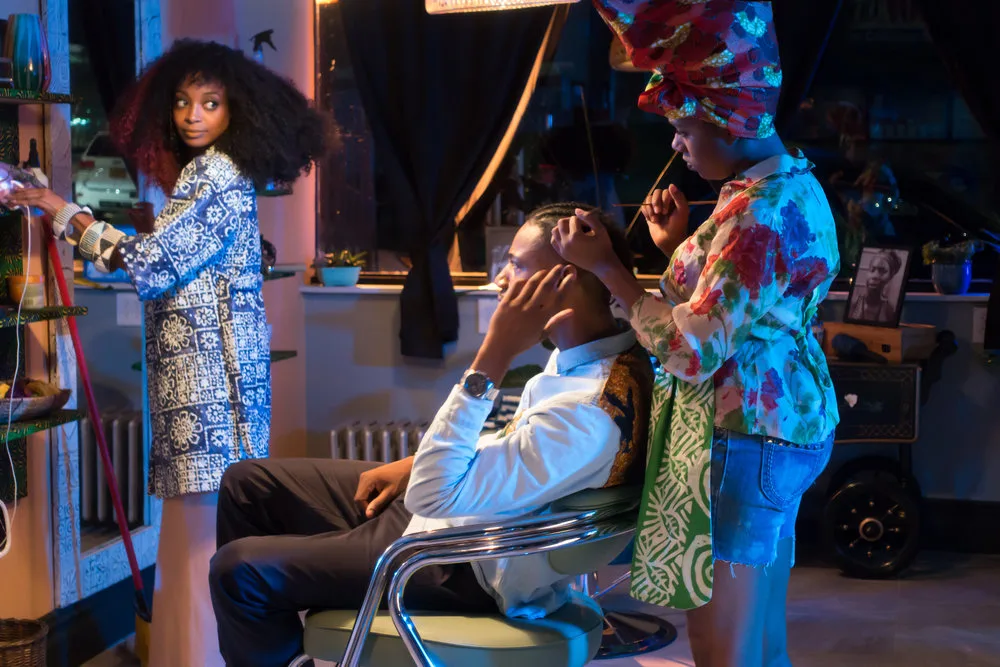
Hair Wolf, U.S.A. (Director and screenwriter: Mariama Diallo)  In a black hair salon in gentrifying Brooklyn, the local residents fend off a strange new monster: white women intent on sucking the lifeblood from black culture.

[taq_review]

About Mariama Diallo
Mariama Diallo is a writer and filmmaker who lives in Brooklyn, New York. Mariama won a Mortimer Hays-Brandeis Travel Fellowship to shoot the documentary project “I Saw a Cross,” which is currently in post-production and is being produced by filmmaker Terence Nance. Along with director Frances Bodomo, Mariama cowrote “Everybody Dies!” which formed part of the ‘Collective:Unconscious’ omnibus that premiered at 2016’s SXSW Film Festival and which The New Yorker’s Richard Brody described as “a sharply satirical parody.”
Mariama graduated in 2010 from Yale University as a Film Studies and Political Science double major. This course of study laid the foundation for a cinematic approach that seeks to integrate social and political themes into film.


Content Courtesy Of Nairobi Fashion Hub & Sundance Organazation

Black Panther Official Trailer

After the death of his father, T’Challa returns home to the African nation of Wakanda to take his rightful place as king. When a powerful enemy suddenly reappears, T’Challa’s mettle as king — and as Black Panther — gets tested when he’s drawn into a conflict that puts the fate of Wakanda and the entire world at risk. Faced with treachery and danger, the young king must rally his allies and release the full power of Black Panther to defeat his foes and secure the safety of his people.

Release date: February 16, 2018 (USA)
Director: Ryan Coogler
Production company: Marvel Studios
Producers: Kevin Feige, David J. Grant
Screenplay: Ryan Coogler, Jack Kirby, Joe Robert Cole

Black Panther Official Poster Done By Marvel Studio

[taq_review]

Official Synopsis: “After the events of Marvel’s Captain America: Civil War, King T’Challa returns home to the reclusive, technologically advanced African nation of Wakanda to serve as his country’s new leader. However, T’Challa soon finds that he is challenged for the throne from factions within his own country. When two foes conspire to destroy Wakanda, the hero known as Black Panther must team up with C.I.A. agent Everett K. Ross and members of the Dora Milaje, Wakanadan special forces, to prevent Wakanda from being dragged into a world war.” The new teaser trailer for Ryan Coogler’s Black Panther aired on ESPN on 8th, introducing Andy Serkis as the film’s primary antagonist. As Ulysses Klaue, an arms dealer working in South Africa, he has a personal and vague vendetta against Wakandan king T’Challa and the rest of the nation of Wakanda.

Read more  no next  page

The Last Animals Film

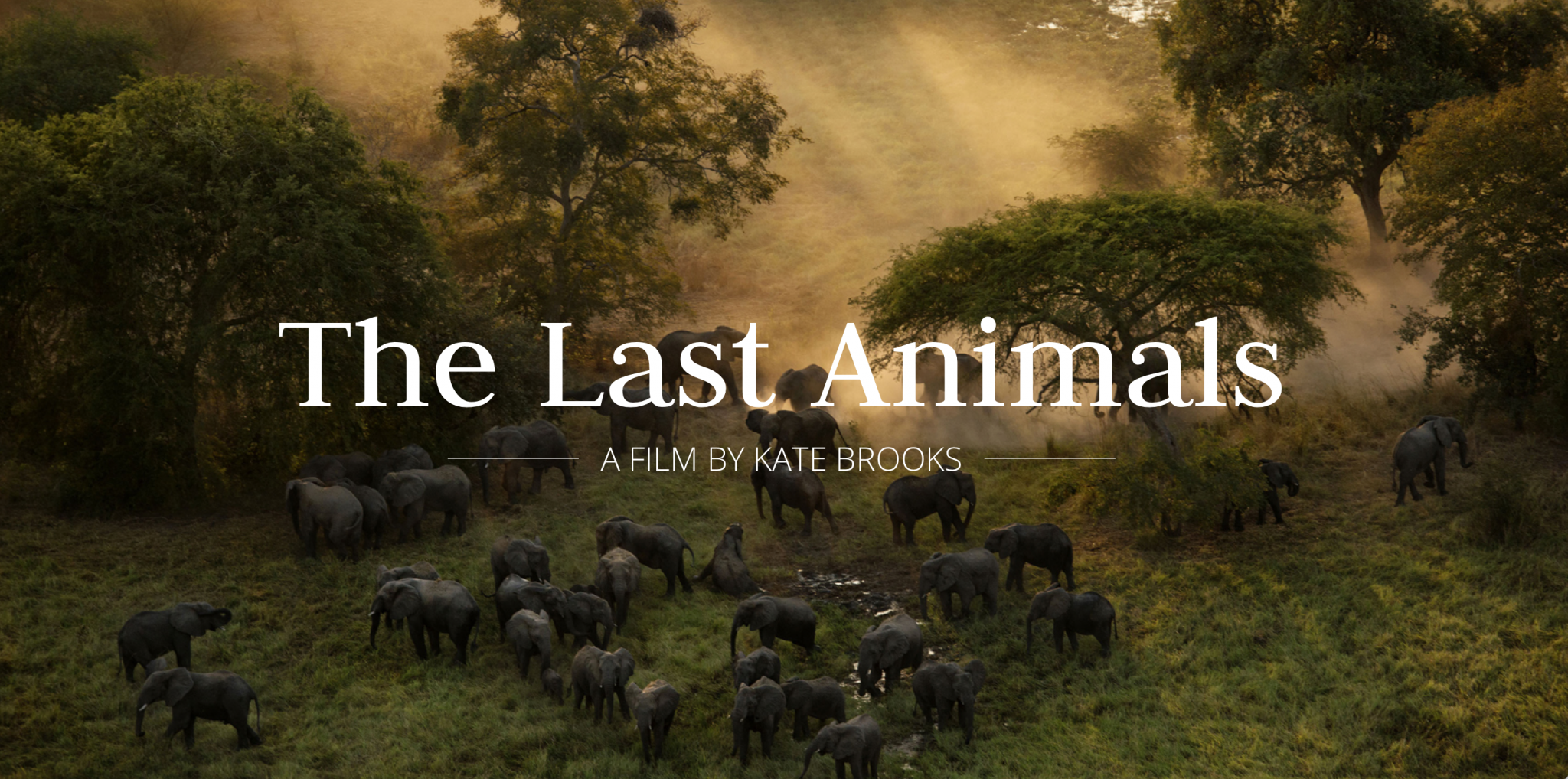
The Last Animals is a story about an extraordinary group of people who go to incredible lengths to save the planet’s last animals. The documentary follows the conservationists, scientists and activists battling poachers and transnational trafficking syndicates to protect elephants and rhinos from extinction. From Africa’s frontlines to behind the scenes of Asian markets to the United States, the film takes an intense look at the global response to this slaughter and the desperate measures to genetically rescue the Northern White rhinos who are on the edge of extinction.
The film is directed by photojournalist Kate Brooks.

Kate Brooks is an American photojournalist who has chronicled conflict and human rights issues for nearly two decades. In 2013 she was awarded a Knight Wallace Fellowship at University of Michigan where she researched the poaching crisis before directing The Last Animals.


About the Film
Conflict photographer Kate Brooks turns her lens from the war zones she is used to covering to a new kind of genocide- the killing of African Elephants and Rhinos- in this sweeping and sobering expose of an underreported crisis. As the single-digit population of Northern White Rhinoceros ticks closer to zero, Brooks outlines the myriad factors contributing to the current epidemic of highly effective poaching and trafficking syndicates, drawing startling connections between the illegal wildlife trade and international terrorism and border security. But all is not yet lost- at the same time, Brooks documents the heroic efforts of conservationists, park rangers, and scientists to protect these animals on the verge of extinction in the face of seemingly insurmountable odds. The result is a potent plea for worldwide attention and action to combat the permanent loss of these majestic creatures.
~Deborah Rudolph~

[taq_review]

Content Courtesy Of The Last Animals and Atlas Film

Watu Wote All Of Us Film 

Watu Wote / All of us. For almost a decade Kenya has been targeted by terrorist attacks from Al-Qaeda and the Al-Shabaab. An atmosphere of anxiety and mistrust between Muslims and Christians is growing. Until in December 2015, muslim bus passengers showed that solidarity can prevail.

The 2015 Mandera bus attack that was immortalized in a film Watu Wote: All of us the film  won an Oscar Award for Short film .
[taq_review]

Watu Wote was produced in 2016 as the graduation film for the Hamburg Media School master class program,This film won Oscar Award for Student category

Katja Benrath from the media school who won the narrative category for the short film stated that it was a tribute to the 28 people killed by Al-Shabab militants who attacked the bus.
“The filmmaker says the movie is a tribute to the 28 people killed by jihadist group Al-Shabaab who attacked a Nairobi-bound bus in Mandera near the Kenya-Somali border in 2014,” said Benrath.

The movie tells the story of that fateful day when suspected Al-Shabab militants waylaid and attacked a Nairobi-bound bus.
The militants demanded that the Muslim passengers on the bus separate themselves and identify Christians amongst them.

Content Courtesy Of Digital Team

Oprah Winfrey Give a Powerful Acceptance Speech at the Golden Globes Awards 2018

As she accepted the Cecil B DeMille Lifetime Achievement award, Oprah gave a powerful speech about sexual harassment, racial injustice and press freedom Oprah Winfrey brought the Golden Globes audience to their feet with a powerful speech as she accepted the Cecil B DeMille Lifetime Achievement Award on Sunday night.

After an introduction by Reese Witherspoon, the actor and philanthropist took to the stage to address racial injustice and sexual abuse on an evening in which women wore black to show support for the #MeToo movement.

Oprah Winfrey takes on sexual predators in Golden Globes speech: ‘Their time is up

Winfrey said: “In 1982, Sidney received the Cecil B DeMille award right here at the Golden Globes and it is not lost on me that at this moment, there are some little girls watching as I become the first black woman to be given this same award. It is an honor – it is an honor and it is a privilege to share the evening with all of them and also with the incredible men and women who have inspired me, who challenged me, who sustained me and made my journey to this stage possible.”

Read more  no next  page

Fundi-Mentals Film Official HD Trailer

Fundi-Mentals is a 2015 Kenyan erotic comedy that was directed by Alexandros Konstantaras, who was also behind the House of Lungula that featured judge Ian Mbugua, the comedy has already been nominated in this year’s Africa Magic Viewer’s Choice Awards in the best actor in comedy award. The film stars Charlie Karumi, Gerald Langiri and Lizz Njagah.

Production
The word ‘Fundamentals’ is very popular among Kenyans, only that here it bears a different meaning from its original one. The word gained massive popularity after Ken Wa Maria, a local Kamba musician, sang a song entitled fundamentals purportedly referring to the ‘assets’ of a woman and since then the word became Kenyan slang term for the latter. Judging from the title, House of Lungula and now Fundi-mentals, the very common ‘naughty’ and very familiar Kenyan slang for the storylines and this only means that the movies tell the Kenyan story. As the producer Alex Konstantaras revealed, the idea for Fundi-mentals was inspired by a scene during the filming of House of Lungula. “There is a scene where the main character (Gerald Langiri) pretends that he is a fundi who fixes a chimney in order to come out from a difficult situation and that scene inspired me to come up with a character about a fundi who thinks that he can fix anything using unprofessional means,” Alex said. Actress, Lizz Njagah announced in July 2014 that the movie will also be available in Luo and Kikuyu dialects.

[taq_review]
Plot
The storyline of Fundi-mentals revolves around the lives of two Fundis (handymen), Joseph (Gerald Langiri) and his assistant Moses (Charlie Karumi) who like to think of themselves as the best Fundis in Kinoo estate despite their unorthodox methods of fixing things. But the entry of a new Multinational Service Company in town throws all this in jeopardy. To avoid going out of business, they introduce to their female customers a new type of Ex-press service with hilarious consequences.

Content Courtesy Of Nairobi Fashion Hub

Something Necessary

Something Necessary

Something Necessary opened in cinemas on Thursday 24th January 2013 to a lot of excitement. I was at the premier that was at The Junction and you could feel the anticipation in the air. There was a red carpet, cameras flashing, dressed up ladies and gents and an after party at the Wine Bar and Mercury both at The Junction. The premier was open to members of the public at just Kshs 450 which is a pretty good deal as most premiers are overpriced. So if you weren’t there, I don’t know where you were!

[taq_review]

The film is directed by well-known Kenyan Director, Judy Kibinge and produced by Ginger Ink Films and One Fine Day Films who produced Soul Boy and Nairobi Half Life. It tells the story of Anne (played by Susan Wanjiru) and Joseph (played by Walter Lagat). Anne is a survivor of the post-election violence (PEV) that rocked Kenya in 2007/2008. Her husband is murdered, her son is in a coma and she herself is hospitalized after a gang of youths breaks into their home at the height of the PEV. Joseph is a perpetrator of the PEV and was one of the youths that broke into Anne’s home. Fate unites the two characters when Anne begins to rebuild her home and Joseph is hired as a casual labourer by the Contractor working on Anne’s house.

Read more  no next  page

Nairobi Half Life

Nairobi Half Life is a 2012 Kenyan drama film directed by David “Tosh” Gitonga. The film was selected as the Kenyan entry for the Best Foreign Language Oscar at the 85th Academy Awards, but did not make the final shortlist, and is the first time Kenya has submitted a film in this category

At the 33rd Durban International Film Festival, Joseph Wairimu won the award for Best Actor. He also won the Africa Movie Academy Award for Most Promising Actor from the Awards 9th ceremony.

It won the most awards at Africa Magic Viewers Choice Awards 2014.

A young man, Mwas (Joseph Wairimu) still lives with his parents in their rural home in Kenya. He makes a living by selling western action films, he dramatically acts and portrays most of the action figures in his films in order to entice his customers. He is an aspiring actor, and when he comes across a group of actors from Nairobi performing in his town, he asks one of them to help him jump start his acting career. But, in return, he is asked to give ksh1000 (approximately US$10) in order for him to be cast in one of the plays. He can only afford ksh500 and is told to take the other 500 with him to the National theatre in Nairobi. He is very excited, and, after receiving some money from his mother, he embarks on his journey to Nairobi with a brief stop over in his town to bade his friends goodbye. He meets his cousin (a gang leader) who gives Mwas an expensive radio system and some money to take to Khanji electronic shop in downtown Nairobi.

[taq_review]

After making his way to Nairobi, he quickly learns that there is more to Nairobi than just opportunities and glamour. On the first day, Mwas loses everything he has to Nairobi thugs and is left stranded and confused especially because he knows no one. He gets arrested and even spends a day in jail. In a twist of events, he meets a Nairobi crook Oti (Olwenya Maina) who becomes a close friend and takes him into his criminal gang. The gang itself specializes in snatch and grab thievery with vehicle parts being their main targets. During this time, Mwas auditions and successfully lands a part in a local play set up by Phoenix Players. He finds himself struggling and juggling the two separate worlds. Mwas finally meets his cousin again who ends up forcing him to steal a car in order to clear his debt. He convinces the gang to move up from stealing parts to stealing cars in order to earn more. During that time, he falls in love with Oti’s onscreen love interest Amina, coming to see her at the lodgings at which she receives customers and even taking her out to the films.

Content Courtesy Of Nairobi Fashion Hub Online Digital Team

Soul Boy Film

Soul Boy is a 2010 Kenyan drama film, written by Billy Kahora and directed by Hawa Essuman. It developed under the mentorship of German director and producer Tom Tykwer in Kibera, one of the largest slums in the African continent, in the middle of Nairobi, Kenya. The film has received five nominations at the 2011 African Movie Academy Awards.

[taq_review]

The film originated in a workshop for young film enthusiasts from Nairobi, guided by German director Tom Tykwer.

Nairobi, Kenya. 14-year-old Abila lives with his parents in Kibera, one of the largest slums in East Africa. One morning the teenager discovers his father ill and delirious. Someone has stolen his soul, mumbles the father. Abila is shocked and confused but wants to help his father and goes in search of the right remedy. Supported by his girlfriend Shiku, he embarks on an adventurous journey that leads him right to the heart of the microcosm that is his hometown.

Content Courtesy Of  Nairobi Fashion Hub Online Digital Team

Veve Film

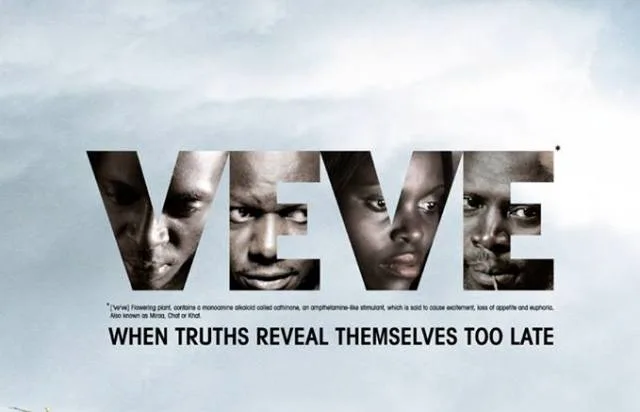
Amos, an unscrupulous local Member of Parliament, wants to become Maua’s Governor in the upcoming elections whilst expanding his business interests. He is a key supplier to the exporter of veve, Wadu, a shrewd businessman, who commands a sizeable share of the business.

Following a conversation with his backdoor accountant, Amos sees an opportunity to upgrade his working relationship with Wadu and acquire a bigger stake in the business. He shares his plan with his right-hand man Sammy, who has been instrumental in building Amos’ influence, doing the dirty work for him. But Sammy’s penchant for such assignments is waning. Still mourning his wife’s death despite the passage of a few years, Sammy is struggling to connect as a father with his rebellious, glue-sniffling son Kago.

Amos’ bold plan hits a snag when Wadu brushes off his proposal, driving Amos into taking things by force. He puts in motion a chain of events to drive Wadu out of business. Meanwhile, veve farmers in Maua who get peanuts for their crop want to better their lot by forming a union, led by the elder man Mzee.

Amos’ ambition has gradually led to a flagging marriage with his wife Esther, though he does not seem to notice this. Esther enjoys the comfort of the wealth he has but misses out on the affections of a loving man. When she discovers he is sleeping with other women, she does not take it lightly anymore.

Kenzo, an ex-convict, is a bitter man seeking revenge by hunting down the man who killed his father: Amos. He attempts to assassinate Amos at a campaign rally and fails. Undeterred, he seeks the help of fellow ex-convict Julius, and they hatch a multi-pronged plan to attack the business interests of both Wadu and Amos simultaneously, triggering a fatal clash between the two and ultimately destroying Amos.

In a twist of events, Esther’s and Kenzo’s paths cross and she ends up finding solace in his arms, totally oblivious that she is falling for her husband’s grim reaper. Elsewhere, Wadu suspects that his troubles have something to do with a competitor.

Sammy burns down Mzee’s farm as a lesson to the unionists. As Mzee’s grandson Morris wonders what to do next, his impulsive friend and wannabe documentary filmmaker Clint tries to confront Amos, which only makes matters worse.

Inevitably, things boil over. Kenzo and Julius raid both Amos’ and Wadu’s business interests, and Julius pays with his life. Amos hunts down Kenzo as Sammy is torn between obeying his orders and finding his son who has run away from home. Esther struggles between being faithful to the man she married and saving the man she just met. Wadu’s patience runs out after he finds out the source of his troubles, and he hires an assassin to finish off Amos.

[taq_review]

Background

Following the success of the feature film Soul Boy, One Fine Day Films and Kenyan-based production company Ginger Ink partnered with DW Akademie to design a two-module training initiative: One Fine Day Films Workshops.

The first module, a classroom-like “mini-film school”, deepens and expands the skill set and cinematic language of already practicing African filmmakers. It widens cinematic perspectives, exposure, and vocabulary. From 18–29 June 2012, the third ONE FINE DAY FILM Workshops were held in Nairobi, Kenya.

56 participants from eleven African countries were invited to enhance their skills in the fields of directing, production, scriptwriting, editing, sound, production design, and cinematography under the mentorship of experienced film professionals.

Out of those participants, a creative team from all departments was formed to shoot VEVE nine months later: Simon Mukali from Kenya was selected to direct the movie, mentored by Sven Taddicken. Egyptian participant Mayye Zayed and Kenya’s Shiv Mandavia as the cinematographers and many more in various departments – Veve was born. Written by Kenyan Scriptwriter Natasha Likimani, it is a high-octane multi-character story that gives a glimpse of the contemporary realities within the Khat trade in Kenya.

Content Courtesy Of Digital Team

Ndoto za Elibidi Film

“The story pivots around the theme of acceptance and love as its colorful protagonists (parents, four daughters and their lovers) come to terms with HIV and ghetto life.”

Dreams is the story of two brothers who travel to Nairobi to find work. Interspersed with songs and plenty of broad comedy, the play follows their fortunes and that of their children as they struggle with issues of love, loyalty, ignorance and forgiveness against the backdrop of the teeming city. In 2009, Dreams was produced as S.A.F.E’s first feature film with the aid of a grant from Keep A Child Alive. The film tells the story of George Elibidi and his family’s survival and final triumph over HIV, and in the process covers issues such as PEP treatment for rape victims, ARV use, stigma and discrimination, condom use and circumcision.

Ndoto Za Elibidi, S.A.F.E.’s first full-length feature, is many things at once: a stage play turned into a feature film, a documentary and a testimony on the impact of the plays message. It was devised originally as a stage play with actors from the Nairobi slums. The story pivots around the theme of acceptance and love as its colourful protagonists – parents, four daughters and their lovers – come to terms with HIV and ghetto life. Cutting back and forth from fiction to documentary, from the original stage play to the actual locations, it takes us on two parallel journeys: we watch the film, but we are also watching it through the eyes of the ghetto audience as they watch the play tell the story of their lives. This extraordinary position gives us a double pay off.

The play was performed for over five years throughout the Nairobi slums, reaching over half a million people. The film version was made after repeated requests from partnering schools and clinics for a DVD version of the performance.

[taq_review]

Ndoto za Elibidi has won several International Awards 

Zanzibar International Film Festival 2010
Golden Dhow for Best East African Talent
Ousmane Sembene Award Commendation

Kenya International Film Festival, Nairobi 2010
Special Jury Prize ‘for speaking powerfully and critically across class, gender and national divides’

Festival of African Cinema, Verona 2011
Verona Award for Best African Film

Kalasha Film and Television Awards 2010
Best Feature Film
Best Editing
Best Supporting Actress

Kerala Film Festival 2011
Official Selection

Tarifa Film Festival 2011
Official Selection

Africa In The Picture Film Festival, Netherlands, 2012
Audience Selection: Best Feature Film

Publication date
2010
Copyright date
2010
Title Variation
English language title: Dreams of Elibidi
Note
Copyright notice on video: S.A.F.E. ; 2010.
Originally produced in Kenya as a motion picture in 2010
Wide screen.
Production Credits
Director of photography, Guy Wilson ; edited by Carole Gikandi Omondi ; sound, Willie Kiumi, David Kinyanjui ; original music, Eric Wainaina, Jeffrey Weeks Harrison.
Participant
Juma Williams, Sharleen Njeri, Mercy Wanjiru, Krysteen Savane, Ednah Daisy, Ummul Rajab, Godfrey Ojiambo, Jacquey Nyaminde, Joseph “Babu” Kimani, Paul “Kadez” Njogu, Eric Ndung’u, Triza Kabue, Sam Kihiu, Alfred Calypso, Irungu Wairimu, Caroline Midimo, Kamau wa Ndung’u, Lucy Waithaka, Melissa Ommeh, Mercy Makokha, Peter King, Small Ogutu, Stevejones Mugo, Elly Yang, Eunice Njoki, Badiza, Doreen Mwajuma, Miles Lekan Kihiu, Erica Winnie Wairimu, Christabell Calypso, Eileen Ojiambo, Zelma Kiruma, Itch “The chairman”, Eric Wainaina.
Funding Information
Funded by Keep a Child Alive
Format
Disc characteristics: Recorded DVD.

Content Courtesy Of Digital Team & Safe Kenya Org

Ad