Sunday 31st of May 2026

Nairobi, Kenya

Kikafri Collections launches Kickstarter Campaign for African Fashion Style

Kikafri Collections has proudly announced that it is producing and marketing the iconic African style fashion from Kenya at a global level. In early 2020, the Christian Business Angels (CBA), angel investors based in The Netherlands entered into a shareholding partnership with Kikafri Collections, which gave a new life to the brand.

The slogan of this inspiring African brand is ‘Design your piece of Africa’ and the company remains true to every word of this slogan. To grow and expand its global reach, the brand is currently crowdfunding on Kickstarter, where it is welcoming generous community support and backing.

https://www.instagram.com/tv/CWS2UvtF38_/?utm_source=ig_embed

“As a brand, Kikafri Collection is aiming for global recognition by spreading our unique sense of fashion, and we emphasize individual style by enabling our clients to “design their own piece of Africa.” Said Johnny Kibilige, while introducing this project to the Kickstarter community.

The brand is not only life-changing for its customers but even more so for the skilled young Kenyans by offering them employment opportunities and enabling them to improve their lives. The covid pandemic struck hard at Kenya as well, amongst others by making most tourists, a key market for Kikafri, stay at home.

All funds raised through this Kickstarter campaign will enable the company to increase its manufacturing capacity by opening a workshop, purchasing sewing equipment, and opening a shop in the Karen shopping mall of Nairobi, Kenya.

Backers from around the world can become a part of this project by making pledges. Moreover, the goal of this Kickstarter campaign is to raise a sum of EUR 9,000 and the brand is offering a wide range of rewards for the backers with worldwide shipping. Furthermore, more details are available on the Kickstarter campaign page of the project.

About This Project

Kikafri Collections (www.kikafri.com) is a Kenya-based African fashion startup aimed at producing and promoting customized African fashion to all corners of the world. From bags to sandals and other fashion articles, the product line of customized Kikafri range is extensive, and growing every day. Moreover, the company is currently crowdfunding on Kickstarter to grow and expand, and to get worldwide recognition for its growing product line.

The Kickstarter Campaign

Content courtesy of  Digital Journal , Kikafri & Nairobi Fashion Hub


Debonair Afrik Launches “ Style Lounge Platform ” Young and Emerging Designers

The Style Lounge Platform launches officially for emerging designers on its website this November 2021, with emphasis on Community, Innovation, and Collaboration. It is premised on a unique and rich African culture and how growing up in a typical African setting can influence greatly a ‘creative and stylish’ African child.
Themed “A Part of Me”, the Style Lounge Platform is an initiative of Debonair Afrik birthed in 2017 with a focus and commitment to building fashion brands and promoting fashion businesses.

Founder of the platform, Emmanuel Ekuban, known within the fashion fraternity as Nuel Bans shares his excitement at the launch of the Style Lounge Platform saying, “We created this platform to shine a spotlight on emerging designers in the fashion industry and provide participants with an all-new and  refreshing view of fashion blending the African fashion style trends while maintaining the highest international standards of fashion.”

The platform builds a community of new and emerging fashion designers while giving them the opportunity to showcase their designs. The designer community features an appreciable number of reputable African designers like Atto Tetteh, Alwoman, Bloom by Edzi, Bushai Weave, Djoulde, Dufie Boateng, Ekua Addo, Feb By Serwaa, Groomsmen, Hazza, Kai Shika, Larry Jay Couture, MxDonna, Nuna Couture, Olooh, Sena Bryte, Steve French, Talensigh, along with their biographies, press releases, lookbooks, stockist lists and relevant links to digital showrooms, and also find latest collections, catwalk shows, shoppable links and editorial content from the designers.

The Style Lounge, since its birth in 2017 has organized 3 successful events each year from 2017 to 2019 under the Style Lounge Weekend. The annual event is aimed at bringing together fashion brands and creatives, to network and encourage emerging brands with the needed platform to market their wares.

The Style Lounge has also introduced 3 projects: the Dots Trade’, Graduate Fashion Showcase, and Design Intern Fellowship, which all serve unique purposes but are centered around fashion businesses, brands, and designers.
The community works with African designers to promote local fashion talents through trade, originality, and sustainability with its flagship project: The Dots Trade’. The event creates a series of fashion exhibitions and pop-ups that seeks to strengthen the socio-economic enterprise by tapping into the fashion value chain.
To join The Style Lounge Platforms community of young and emerging fashion designers,

Designers can now fill and submit the form on The Style Lounge Platforms or Debonair Afrik

Connect with us on Social Media
Facebook: Style Lounge Platform  
Twitter: @DebonairAfrik 
Instagram: @debonairafrik @styleloungeplatform

Content courtesy of Debonair Afrik & Style Lounge Platform 


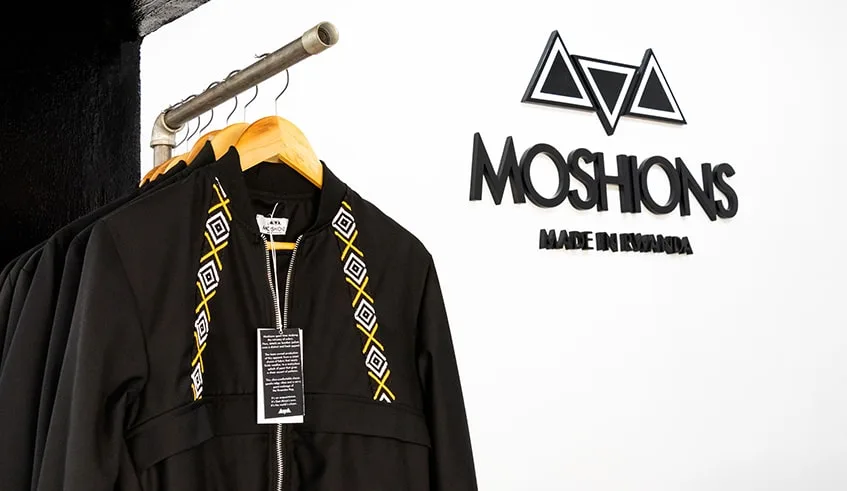
Moshions launches Imandwa Fashion Collection SS22 in Kigali, Rwanda

As live fashion events made a disappearance under the Covid glare, the launch of Imandwa Fashion Collection by Rwanda’s Moshions Fashion House has relit the stage and set a blistering pace for the fashion industry.

Imandwa has also sparked debate on the critical but uncomfortable discussion surrounding gender stereotyping and masculinity and their place present traditional and contemporary society.

The November 8 and 9 showcase at Atelier, the newly re-launched space in Kimihurura, Kigali, rekindled the space that audiences knew events to be.

Easing of the pandemic-related lockdowns saw a gradual return of music concerts but Imandwa took to fashion.
Of note about this collection is the bringing together of the handicraft of Moses Turahirwa of Moshions, who designs outfits inspired by traditional and ancient art and designs. Right from Umwitero, the traditional wearable robe, complimented with entwined beadwork from the Imigongo, an ancient art form, into various finishes.

Cedric Mizero of Amizero Designs sparked debate especially for his unique makes; of abstract craft inspired by life and nature themes like the environment, space, and the wild, which he believes speak to generations.

This year’s collection follows their first collaboration last year where they produced the Zero-Waste Jacket, a long-sleeved stylish unisex outfit designed from recycled remains of leftover cloths pieces.

Striking difference
Unlike the typical fashion events where models graced the runways, Imandwa is a fixed exhibition, of live fashion models posing amidst traditionally crafted and preassembled fore and backgrounds, which occupy Atelier’s upper space.

A lively curated tour guide by the designers themselves takes the audience through their creations.
Male models dressed in jackets, shirts, and shorts, made mostly from wool, and silk. The outfits sport partially hand-dyed baselines along with the trousers. To add sparkle, they are ornamented with tailored hand-beaded embroidery of traditionally shaped craft. The outfit is supplemented with the Umwitero, a light silky robe that is wrapped from the shoulder, chest to waist.

The showcase is backed by well-crafted traditional sets, of a different make. One has bean ornaments, another stands amidst hundreds of bricks. Yet another in between clay pottery, while the last two models emerge from what seems like a grass-thatched African village hut.

Gender stereotypes
Imandwa brings to fore tradition. Even in their past collections, there has been a running theme to address gender stereotyping, with masculinity at the fore.

The male models, clad in African masks designed to emulate Rwandan faces of Amasunzu, an ancient hairstyle, emerge from the background and stand. For a few minutes, they look straight up, then slowly take off the mask, pose a little more before returning to their hideouts or safe spaces.

Content courtesy of East African & Nairobi Fashion Hub 

Fast Fashion? No Thanks, I Care About Our Planet Mama Earth

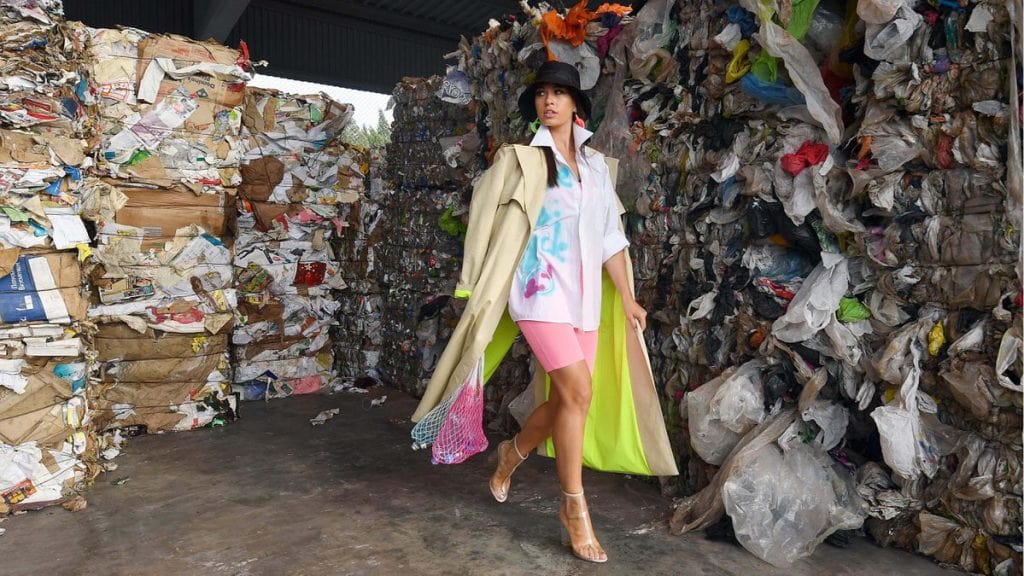
Clothing, especially from fast fashion, is a major contributor to global warming and pollution. Mountains of discarded garments end up in West Africa.
The $2.7-trillion fashion industry is one of the largest, most resource-intensive sectors in the global economy, and it has a devastating impact on our environment.

The extraordinary success of “fast fashion” giants like H&M, Zara, and Forever 21 stems from their ability to produce a massive amount of clothing billions of garments a year in the cheapest and quickest manner possible. An article of clothing often travels through dozens of countries and hundreds of hands and ends up being worn only a few times.

Consider the statistics:

  • A single cotton shirt or ‘eco-friendly’ cloth grocery bag requires 2,700 liters of water to produce.
  • The fashion industry produces approximately one-third of all microplastics found in the ocean.
  • Global cotton production is estimated to produce 220 million tons of CO2 emissions each year. Experts say the industry accounts for 10% of greenhouse gas emissions. Workers mostly women earn low wages.
  • The average consumer buys 60% more clothing than 15 years ago.

Fast-fashion choices are ending up in landfills.

These numbers, as dire as they are, account for only the production half of the story.

What happens when these clothes are no longer of use or no longer “in style”?
The Council for Textile Recycling reports that the average American throws away between 70 and 81 pounds (30-36 kg) of clothing and other textiles annually. Globally, 17 million tonnes of clothes go to landfills mostly in the Global South.

Although many people believe that donating clothes is environmentally friendly, according to the U.S. Environmental Protection Agency, 84% of all clothing eventually ended up in landfills or incinerators in 2012, even if they were donated.
Not only are fast-fashion choices of the Global North ending up in landfills, but they are also often traveling thousands of miles and creating tonnes of CO2 to get there.

Ghana in West Africa is a common dumping ground.

A common dumping ground for discarded and unwanted cheap clothing is in West Africa. Accra, the capital of Ghana, receives approximately 15 million used garments per week, or 70 tonnes per day, of which approximately 40% are of such low quality they go immediately to the landfill.

The remainder is sent to be sold in one of the largest garment markets in West Africa  Kantamanto Market.
It is important to note that Accra’s landfills are already almost entirely full, and the country is struggling with its own internal waste management issues.

In Ghana, about 12,710 tons of solid waste is generated every day, and only 10% of that is collected and disposed of at designated dumping sites. Waste pickers who spend the day picking trash and managing the landfill’s recycling and sorting work under dangerous conditions. They account for a significant portion of the recyclables sorting and waste management in Ghana.

Johnson Doe, President of the Kpone Landfill Waste Pickers Association, is one of the hundreds of waste pickers who spend their days in Accra’s largest landfills. He sorts trash and pulls recyclables from the massive mountains of garbage. He also spends time training and organizing waste pickers to demand fair wages and healthcare.

“In Ghana, there is no law that guides waste pickers,” Doe said. “The recycling of waste, the management of waste, we know a lot. So we decided to organize ourselves seven years ago. We want to be recognized by the community, recognized by the government, and we want to be involved in the decision-making to protect ourselves.”

Doe said it is difficult to sort so much fabric. “Clothing waste is one of the major problems we faced at the landfill because it takes more space and when it is mixed up with the waste, we find it difficult to find and salvage the recyclables.”

Our clothing choices are no longer sustainable for the environment.

The garment markets in Accra are feeling the impact of too many clothes. According to OR Foundation, which has been studying Kantamanto Market for more than a decade, “the Global North is relying on Ghana to take part in a waste management strategy necessitated by relentless overproduction and overconsumption.”

Although many citizens in Accra rely on these clothing distribution sites for income, the broader impact on the community and the country is significant. The overflowing landfills pollute water supplies, produce constant smoke, and generate risky, low-wage jobs.

“This isn’t sustainable anymore,” said Dr. Katherine Duffy, a senior lecturer at Glasgow University.
“The most sustainable clothes that we have are the ones we already own. If we can start thinking about care, maintenance, longevity, and how we treat those garments, then we are already starting to think in a more sustainable fashion.”

Duffy recommended ways to think differently about clothing.
“Consumers at the moment have so much readily available information about the problems associated with high demand for new clothing, combined with the global trend of the ever-decreasing lifespan of garments and also the environment and social impact of those behaviors,” she said

“But I’m also excited by some of the new behaviors that are starting to emerge. We need to focus on the four ‘R’s’  repair, resale, reuse, and rental. These options are really a way for us to think about how we engage with our items as well as the care and attention we want to place on the garment and how we can preserve it for its next life.”

Content courtesy of News Decorder 

Ethiopia Hosts Africa Fashion Gala 2021 At The Skylight Hotel In Addis Ababa

The Africa Fashion Reception, an annual fashion gala has returned to Ethiopia coinciding with the African Union theme for the year “The AU Year of the Arts, Culture, And Heritage: Levers for Building Africa We Want”.

This 2021 edition was held at the Skylight Hotel in Addis Ababa on October 22, a year after it was suspended because of the COVID -19 pandemic.

“It has been very difficult, I think this is the first time the designers are all coming out after the pandemic,” explains Lexy Mojo–Eyes, president of Legendary Gold, the company organizing the event.

“We were expecting 30 designers from 30 countries, but the pandemic has reduced the number, or some it was either because of COVID protocols, the other was about visa fees as a result of COVID, we are hoping that the future will be brighter for all of us,” says Nkosinatyaso, a designer from South Africa.  “For the 15 designers that made it, it was a chance to show the world the beauty of their creativity. Our Africa fashion is very unique unlike overseas and every other culture, so I think we need more platforms where we can show the world what we are made of as Africans.”

However, those who have been in the industry longer say Africa has not yet got the value it deserves from the industry.

“It is about time that African Union supports their own,” says Sant Anzo the director of
Arapapa by Santa, a Ugandan Fashion company, The African Development Bank values Africa’s textile and the fashion industry at 1.3 trillion dollars.

Obstacles to its growth include having over 90% of fashion businesses being small to medium scale. They reportedly stagnate because of lack of government support as well as lack of capital, Others fail because of a lack of intellectual property and the high cost of copyright.

Content courtesy of CGTN Africa & Nairobi Fashion Hub 


Ethical Fashion Initiative to Launch Paris Fashion Week Events

The program is launching a showcase for African designers in a bid to attract investors.

PARIS — The Ethical Fashion Initiative is coming to Paris next season, with events during Paris Fashion Week that it hopes will provide international visibility to African designers and attract investors.

The program, funded and managed by Simone Cipriani, is a flagship initiative of the International Trade Centre, a Geneva-based joint agency of the United Nations and World Trade Organization. What started out as a platform for connecting global lifestyle brands with artisans worldwide has expanded into an accelerator for African brands.

Now Cipriani is ready to take the EFI to the next level, beginning with a launch event on Oct. 30 and 31 in Paris that will include exhibitions, a concert, and round tables with designers Margaux Wong from Burundi and Lukhanyo Mdingi from South Africa, who was one of the joint winners of the Karl Lagerfeld Prize at this year’s LVMH Prize for Young Designers.

The event will be held at the 360 Paris Music Factory in the Goutte d’Or district of Paris, home to several designers who will be hosting workshop visits. The EFI has previously brought designers to events in Italy such as Vogue Fashion’s Night Out, Pitti Uomo, and Altaroma.

“We are going to Paris because it’s a progression,” Cipriani told WWD. “Paris is very open and very close to African fashion traditionally, and Paris has also a very active diaspora with a lot of good designers and with a lot of investors who can invest in these designers.”

Cipriani wants to transform the accelerator into a blended finance facility to mobilize investment from inside the African continent, but also from Europe. “Paris is the ideal place to do that,” he reasoned.

Some of the brands in the accelerator are already in discussions with facilities in Africa for investments ranging from 500,000 euros to 1.5 million euros, Cipriani reported. These typically impact investors or so-called “patient” investors, he added, noting the high cost of working capital financing in Sub-Saharan Africa.

For investors outside the African continent, there are potential returns that go beyond the required return for capital invested, Cipriani noted, citing the example of pluvial cotton grown in Burkina Faso, which has a lower impact on the environment.

“We have this whole value chain in Burkina Faso, where we make fabric out of organic cotton, where we make some garments, there are designers, and so on. So investing in these designers is also a way to get into a decarbonized supply chain, it’s also a way to get in a form of fashion which is consistent with the problems of COP26,” he said. “It’s an investment in ESG, more than a specific brand.”

Founded in 2009, the EFI offers a bridge between brands including Vivienne Westwood, Loewe, and Adidas, and some 10,000 artisans in countries including Burkina Faso, Mali, Kenya, Ethiopia, Uganda, DRC, Haiti, and parts of central Asia, though its program in Afghanistan is currently on hold due to the political turmoil in the country.

For Cipriani, investing in fashion design is also a good way to build social capital in African countries, where creative businesses such as fashion, music, and modeling enjoy huge followings on social networks. Above all, he wants to launch a set of events at Paris Fashion Week that will present African brands as international, rather than niche, labels.

Content courtesy of WWD & Nairobi Fashion Hub 

Lagos Fashion Week 2021: The Future Starts Now

Following a pandemic-induced hiatus, Lagos Fashion Week is finally set to return from October 27th-October 30th at the Lagos Fashion Week Tents, Federal Palace Hotel.

#TheFutureStartsNow is the defining theme for this year’s edition which speaks to the need for a global fashion industry that preserves and conserves the environment and values people over profit.

The future of fashion for the next decade and for many more to come starts now. It begins with a community of rising talents springing up across the continent, and with a commitment from our ecosystem to adopt a functional fashion system that delivers environmental, societal, and economic solutions that are beneficial for all.

To kick-off the season, we spent time with designers Cynthia Abila, Pepperow, Studio IMO, Elfreda, Maliko, TJ Who, Babayo, GETO, and Vicnate, alongside their muses Angel Obasi, Saleema, Deola Adebiyi, Wole Babalola, and Abiola Sonaike, who shared with us, their imaginings on the future of fashion in Africa.

“The Future of Fashion to me means smart production/consumption, sustainability, innovation and technology’ – Omafume Niemogha

“The Future of Fashion to me is inclusivity; Everyone gets a seat at the table”- Samatha Adebayo

“The Future of Fashion is in the metaverse for me, a confluence of physical and virtual fashion” – Edwin Okolo

“The Future of Fashion is wearable technology: Smart and intelligent textiles/footwear and garments are fast becoming the new innovation” – Cynthia Abila

While Lagos Fashion Week returns to the physical tents at Federal Palace, this year’s edition will embrace a hybrid model with digital shows highlighting rising talents from across Africa as well as featuring a distinct exhibition of the selected designers’ collections.

Fashion Business Series, a platform designed to facilitate conversations with key stakeholders in the industry will hold digitally on 27th October 2021. Speakers include Aissa Dione, Busayo Olupaona, Chid Liberty, George Gachara, Laureen Kouassi-Olsson, Mariama Camara, Roberta Annan, Tammy Tinker, and Viola Labi amongst others.

This year, as part of our ongoing commitment, to facilitate new conversations and exchange of ideas surrounding sustainability in fashion in Nigeria and Africa, Lagos Fashion Week is teaming up with Fru Girls and PopSwap-a new digital community for the Global Fashion Exchange to host an inaugural digitally-enabled Swap Shop experience in Lagos which will take place from the 28th-30th of October.

Putting into practice the foundations of a circular economy that prioritizes reuse, reduce & recycle, Lagos Fashion Week will facilitate the exchange of pre-owned items through swapping, sharing, donating, and resale.

#LFW2021 Line-Up

● Fashion Business Series: 27th October 2021

● Digital & Offsite Shows: 28th October 2021

● Physical Runway Shows: 29th-30th October 2021

The countdown is officially on! It’s 7 days to go and the city of Lagos will once again come alive as Lagos Fashion Week returns in full force.

Campaign Shoot Credits:

Photography: Demola Mako
Creative direction: Chuchu Ojekwe
Produced by: Style House Files
Makeup: Wura Salvador
Hair: Lush Hair Nigeria
Muses: Angel Obasi, Deola Adebiyi, Saleema, Wole Babalola, Abiola Sonaike
Shoes: Shekudo, Maliko Studios
Jewelry: Milola Jewels
Models: Beth Modelling Agency (Natse Jeide, Chioma Tagbo )

Content courtesy of Lagos Fashion Week & Nairobi Fashion Hub 

Anji Degante Is Using Her Tampa-based Clothing Business To Help Orphaned Children In Kenya.

A Tampa business accepted into the 5508 Small Business Incubator Program is using the opportunity to make an impact beyond the Bay area.

​Anji Degante, the owner of Accent Styles Boutique, has been inspired ever since her 2014 trip to Kenya. She launched her African clothing business three years ago and now a portion of those proceeds benefit orphan children in that community.

“The Maasai tribe that I lived with were extremely traditional,” she said. “If they did not make it they did not wear it,” Degante says she learned a lot about Kenyan culture while living there.

“I’ve seen a lot of things that I wanted to improve,” she said. I thought that I could change Kenya but I feel like Kenya changed me. It made me a better person. It made me more conscious. It made me take a look into sustainable fashion. It made me look at ways to create cultural retention programs.”

After two years in the small business incubator program, Tampa Hillsborough Executive Action Plan CEO Derrick Blue says Degante’s business has become a bankable small business.

https://twitter.com/FadiaTVNews/status/1447299129579917314?s=20

“We have a lot of success stories from individuals that started off with laptops as coworkers in one of our spaces to now being seven-figure companies,” Blue said.

As she continues to be a success, Degante has been giving back to the community that influenced her brand.

A portion of the proceeds at her shop is helping more than 300 children at a Kenyan orphanage with their education, uniforms, and food. Degante says she felt compelled to step in and help when the orphanage’s leader passed away.

She also opened a library in Nairobi, Kenya with books donated from St. Petersburg and Tampa.

“They are definitely like my adopted children I absolutely love them,” Degante said.  She credits her success both locally and abroad to the opportunity she has with 5508.

“One of the things that I love about the rent being so affordable is that I’m able to buy more product, I’m able to hire more employees and I’m able to donate so much of my time,” she said.

Time and effort she says are fueling our local economy while providing resources and a future for orphans in that Kenyan village.

Content courtesy of Spectrum Bay News 9 & Nairobi fashion hub


Ozwald Boateng The Black Fashion Designer Who Became The Youngest Tailor on Savile Row

The designer dressed the cast of hit films – The Matrix Reloaded, Lock Stock and Two Smoking Barrels, Black Panther, and Bad Boys 2 London is considered one of the most iconic fashion capitals in the world, with some of the biggest fashion designers hailing from the UK.

From Alexander McQueen to Stella McCartney, high-end fashion is sewn into the fabric of city life but there are some designers who have blazed the trail and made their mark in spaces where Black people are rarely seen.

At the age of 28, a Muswell Hill-born designer decided to open up shop on Vigo Street at the end of the world-famous and prestigious Savile Row.

Ozwald Boateng became the youngest tailor to open a store on London’s sartorial street and went on to dress the likes of Rolling Stones’ Mick Jagger, Led Zeppelin’s Jimmy Paige, and stars of Sex and The City to name a few.

Born to Ghanaian parents, Ozwald used his mother’s sewing machine to design his first collection, but before pursuing fashion, the Londoner studied computing and eventually dropped out to enroll at Southgate College.

His career then took off in his 20s after successfully selling his clothing to a menswear store in Covent Garden, after dressing celebrities and musicians, Ozwald went on to open up a store on Portobello Road with his “Structured Classics”, which he created in line with classic Savile Row Tailoring.

In 1994, the Londoner achieved his first groundbreaking move by becoming the first tailor to hold a catwalk show during Paris Fashion Week as he said, “I knew that if I did a catwalk show in Paris as a tailor I could revolutionize tailoring”.

Months later, Ozwald added another first to his accolades by becoming the youngest tailor to set up shop on Vigo Street at the end of Savile Row, the epicenter of suit tailoring.

The sartorial genius incorporated color from his Ghanaian heritage fused with the distinct British tailoring and eventually opened his Headquarters in Savile Row and a flagship store in 2007.

The accolades for his work began to flood in as the tailor received the Award for Best Menswear Designer at the Trophées de la Mode in Paris and credits in Vanity Fair for “leading the way in British men’s tailoring”. In 2002, the fashion designer won Best Menswear Designer at the British Fashion Awards.

Ozwald’s success drew the attention of Hollywood A-listers and the tailor went on to dress the cast of films such as The Matrix Reloaded, Lock Stock and Two Smoking Barrels, Black Panther, and Bad Boys 2.

Away from the camera, the 54-year-old dressed stars for red carpets included the likes of Will Smith, Jamie Foxx, and Daniel Day-Lewis, who wore a diamond cloth suit to the Oscars worth $150,000.

In 2003, Ozwald became Creative Director of menswear for high-end French Fashion House Givenchy as his influence continued to grow internationally.

Then in 2006 the world-class tailor was awarded an O.B.E by the Queen and named an “Officer of the Order of the British Empire” for his services to the fashion industry.

The days of sitting at his mother’s sewing machine were now far behind him as Ozwald continued to be decorated for his great achievements.

The Londoner received an Honorary Degree (Master Of Arts) from The University of Creative Arts as well as an honorary doctorate from the University of Arts London both for his contributions to the fashion industry.

But his recognition from academics wasn’t limited to the UK as the tailor was awarded Harvard University’s Veritas Award.

Not forgetting his roots, Ozwald has been involved in giving back to his origins in Ghana and the continent of Africa overall. In 2006, the designer held a historic show at the state banquet of the 9th annual African Union summit held in Accra, Ghana to recognize 200 years since the abolition of Slavery and the country’s independence from Britain.

Content courtesy of My London & Nairobi fashion hub 

Africa Fashion Week London (AFWL) 2021

The largest annual African fashion event in Europe, Africa Fashion Week London, is back for Season 10!  Africa Fashion Week London (AFWL) is Europe’s largest fashion event promoting and nurturing African and African-inspired design talent

With a collaborative catwalk, exhibition, and business development program, AFWL has led the way in highlighting Africa’s emerging designers and apparel industry and has been at the forefront of bringing awareness of Africa’s burgeoning fashion industry to the international market.  AFWL has hosted 9 catwalk events and contributed expertise to at least 10 more events produced by 3rd parties such as The Mayor of London’s Black History Month celebrations

We have also showcased over 900 emerging designers & exhibitors, from Africa, Europe, and America, to almost 75,000 visitors including buyers, retailers, influential industry professionals, and the media, and is now a highlight on the annual fashion calendar.

AFWL brings value to designers through, contacts, experience, and knowledge within the fashion community. With a core team made up of experienced fashion industry experts and business professionals, AFWL is committed to creating a platform for African and African inspired designers that not only showcases them to an international market but also supports them in building a sustainable business that is globally recognized and promotes social change in Africa.

About Africa Fashion Week London

AFWL has hosted seven catwalk events since its inception in 2011 and contributed expertise to more than 12 events produced by 3rd parties such as The Mayor of London’s Black History Month celebrations and the annual Africa Centre Summer Festival. We have also showcased over 900 emerging designers & exhibitors, from Africa, Europe, and America, to almost 80,000 visitors including buyers, retailers, influential industry professionals, and the media, and is now a highlight on the annual fashion calendar.

Content courtesy of Move Me Back and Nairobi Fashion Hub 

Birimian Unveils the First Cohort of the IFM-Birimian Accelerator x Africa, the Accelerator Program Launched with Institut Français de la Mode

Birimian, the first operational investment company dedicated to African luxury and premium heritage brands, has selected the finalists of its first call for applications (see list below). These finalists will join the acceleration program IFM-Birimian Accelerator x Africa, in partnership with Institut Français de la Mode (IFM). The designers selected will also be highlighted at the Première Classe event organized by WSN as part of Paris Fashion Week on October 1–4, giving the brands valuable exposure to the European fashion scene.

Launched in June 2021, IFM-Birimian Accelerator x Africa is an innovative acceleration program for emerging African heritage brands in the fashion, accessories, and jewelry sectors. Every year for ten months, the program, funded by Birimian, intends to support ten young designers selected by a committee of experts from the international creative scene. The brands participating in the program will also receive investment and/or consulting and support services from Birimian.

The accelerator program provides essential tools to develop emerging brands:

  • Defining a brand platform
  • Strengthening the creative process
  • Targeting the relevant audience
  • Establishing a consistent marketing strategy
  • Financial management
  • Planning and structuring of collections
  • Distribution strategy
  • Communication policy, and more.

This program is a unique opportunity for designers and emerging brands, both on the continent and in the diaspora, to get strategic, operational, and financial support for ten months, thus allowing them to make their activities more professional and organized. It is a program focused on training the young African creative guard and promoting creative entrepreneurship.

The talent identification process took two months and involved scouting, active engagement with brands, and selection of candidates from three segments: ready-to-wear (general public and premium) for 80% of the brands, ready-to-wear fashion (premium and luxury), and accessories for 20%. 85% of them are “made in Africa.” Their collective customer base reflects Birimian’s ambitions with a strong openness to the international market (40%) and significant potential for influence beyond the borders of the continent. 80% of them boast a revenue of over $US50,000, one of the main selection criteria.

The first group, characterized by a geographic diversity representative of the continent’s main economic hubs, illustrates the richness of the brands’ creative worlds. It includes the following finalists:

Laureen Kouassi-Olsson, CEO of Birimian, commented, “The class of designers invited to join the IFM-Birimian Accelerator x Africa program embody the new creative African guard: reinvented tradition, undeniable creative talent, Afropolitan, urban, and digitally focused on the world, proudly showcasing their heritage through collections whose originality no longer needs to be proven.

However, it remains fragile, hence the need to strengthen their basics and provide them with operational, strategic, creative, and financial support. This is the entire purpose of this program, which is fully aligned with our investment strategy. The network of experts it draws on and the unique access to the ecosystem of the French and European creative scene will inevitably create value. We cannot wait to warmly welcome them to Paris alongside Institut Français de la Mode.

“The 10 brands selected for this first intake of the IFM-Birimian Accelerator x Africa are full of creative talent and ambition for their development. The designers and entrepreneurs will work on all the components of their brand with the objective of not only boosting their reputation but also developing sustainable businesses in an international ecosystem while preserving their African heritage.

The right balance will be struck by working together towards creative, inclusive and sustainable entrepreneurship”, concludes Thomas Delattre, Director of the Fashion Entrepreneurship Center at Institut Français de la Mode.

About Birimian
The first operational investment platform dedicated to African luxury and premium heritage brands, Birimian supports designers on the continent in their growth and international development over the long term. Birimian’s main objective is to accelerate the international emergence of African creators by positioning itself as their major partner in four main sectors: fashion, accessories, beauty & cosmetics, and gourmet.
Birimian is aimed at brands that carry the continent’s culture, tradition, history, and cultural heritage, magnificent in its diversity, in their DNA and identity, brands that adapt to modern and contemporary codes.

About IFM
Institut Français de la Mode is a higher education institution, a training center for apprentices, a provider of executive education, as well as a center of expertise for the textiles, fashion, and luxury industries. It offers 16 educational programs at vocational, Bachelor, Master, Executive MBA, and doctorate levels, which prepare students for all the professions in the fashion industry in the fields of management, design, and craftsmanship.
Based in the heart of Paris on a new 9,000 m² campus, Institut Français de la Mode welcomes more than 1,000 students of some fifty nationalities – managers, designers, technicians, entrepreneurs – encouraging meetings, collaborations, and cultural effervescence.

Institut Français de la Mode is a member of HESAM Université, of the Conférence des Grandes Ecoles and of the International Foundation of Fashion Technology Institutes (IFFTI). It is supported by the French Ministry of Economy. It is recognized by the French Ministry of Higher Education.

Content courtesy of IFM-Birimian Accelerator x Africa 


Oakland Clothing Designer Sources Textiles from Africa

How an Oakland clothing designer Ade Dehye is challenging fashion industry norms, sourcing directly from Africa with his 100% Black-owned and operated brand, “Tunde” Ahmad is merging textiles from Ghana with urban streetwear designs.

East Oakland’s Akintunde “Tunde” Ahmad had long wanted to visit the African continent and reconnect with his ancestry. When he arrived at the University of Ghana in Accra in 2016, taking a semester off from Yale to study abroad, he was captivated by everything about the bustling city.

“I was fortunate to be able to go for an entire semester and have a deeper and longer connection out there, learning African history from an African perspective, rather than Eurocentric or American perspective,” he said. “I was able to dispel a lot of myths and stereotypes that are negative, overwhelmingly, and put into our heads about the continent.”

One of the most stunning revelations to Ahmad was how prosperous Ghana’s fashion industry is but not in the fast-fashion, the mass-produced way we’re accustomed to in America. In Accra, you’ll see a lot of people in completely custom outfits, rather than something you’d find at a chain store.

The reason: It’s extremely easy to access affordable tailors, along with endless unique fabrics, from bògòlanfini (traditionally dyed with fermented mud) to woven kente (a handwoven cloth with strips of silk and cotton).

“Even every dorm on campus had a tailor,” he said. Ahmad started getting garments made and visiting different fabric markets. “The tailors get your measurements and can make different custom pieces.”

These experiences laid the groundwork for what is now Ahmad’s successful clothing brand in Oakland, called Ade Dehye, which uses custom West African textiles sourced directly from Ghana to create urban streetwear designs. It’s all operated under an ethical business model that aims to respect, rather than exploit, African culture and workers.

“It was a very natural progression,” he said. “I never really had a huge interest in fashion. But once you actually get to try stuff and see how it looks on yourself, that is how I caught the fashion bug.”

Now, his 100% Black-owned and operated brand works with a dozen tailors in Accra to create around 250-300 pieces at a time. Ade Dehye is known for its fusion of intricate prints stylized as streetwear, bomber jackets, lined trench coats, and two-piece outfits that you can mix and match. The pieces are then shipped to Oakland and sold online or through pop-ups. The timeframe from Ahmad selecting the fabrics and designs to receiving the garments can take anywhere between 10 weeks to five months.

“There needs to be more investment in Ghana, in the continent as a whole,” Ahmad said. “And not just in the clothing industry, but in industrializing the country as a whole, and getting West Africa more up to speed and competitive with the rest of the world in every sector.”

Although Ahmad wasn’t always interested in fashion, he was familiar with West African textiles. His mom often wears clothing made out of West African prints, so Ahmad was exposed early on to textiles like Kente cloth, Ankara, and mud cloths. “I was no stranger to these fabrics. But I’d never been able to get stuff tailor-made to me,” he said.

Ahmad’s path to fashion wasn’t always clear, but he always had a goal to make a difference. When he graduated from Oakland Tech High School in 2014 he was praised on national television for his achievement as a senior who was accepted into some of the most elite Ivy League universities. Ahmad received his bachelor’s in sociology from Yale in 2018, and his master’s in journalism and documentary film from Columbia Journalism School in 2019.

“I got a lot of attention for [my college acceptances], and I always wanted to return the favor to come full circle and actually get into education,” he said of his goal to return home and pay it forward like he watched his mom do as being an educator with the Oakland Unified School District for three decades.

While he wanted to make his way home eventually, he decided to stay in New York to work as a journalist and filmmaker in Harlem after graduating from Columbia. But when COVID-19 hit, he and his partner, Elena, traveled back home to Oakland for what was supposed to be no more than a 10-day shelter in place. They ultimately canceled their return flight to New York and stayed in the Bay Area.

When he came home, he got the opportunity to teach at OUSD’s African American Male Achievement program, designed to improve academic and life outcomes for male students. At the same time, he took part in the prestigious Ida B. Wells fellowship in investigative reporting. While Ahmad was forging a budding journalism career, he never stopped thinking about the time he spent in Ghana. He started dreaming up creating a 100 percent Black-owned brand solely sourced and produced out of Ghana.

Having no fashion knowledge other than what he learned during his time abroad as a college student, he reached out to the people in the fashion industry he had met during his stay back in 2016. One of them was local Ghana fashion designer Awurama Mankatah, owner of the Threaded Tribes clothing brand.

So far, Ahmad has self-funded the entire project, and money generated from pieces sold is reinvested into the brand.

Because tailors in Ghana specialize in making a limited number of custom-made pieces at a time, one of the biggest challenges was recruiting them to be involved. He leaned on Mankatah for guidance on finding the right tailors, as well as learning how long certain handmade fabrics take to make, and the different types of stitching and patterns. The roughly dozen tailors that work for Mankatah also work for Ahmad, and the entire manufacturing operates out of Accra.

For the most part, Ahmad has worked remotely to bring his vision to life, but he was able to travel to Ghana this past February.

From the beginning, Ahmad wanted to ensure his brand helped the African workers he partnered with financially and didn’t become an exploitative source as is the case in so many industries operating on the continent. Cacao is one of the most obvious examples of how Western countries take advantage of West Africa’s natural resources with little benefit to locals. While Ghana is currently one of the largest exporters of cacao, Western Europe and the United States have the highest number of chocolate manufacturers reaping profits.

“You see all of these folks from other places coming in and running things, and you understand this is a raw resource grab,” he said.

Ahmad knew he was taking a risk with his ethical vision for how to run Ade Adehye given how much easier and more lucrative it would be to run the brand out of China’s mass production infrastructure. “I purposefully chose not to do that,” he said.

So far, Ahmad has hosted two pop-ups, one in Alameda in May and one in downtown Oakland in August. During the Oakland pop-up inside Dish Boutique on 23rd Street, friends and visitors got the chance to mingle with Ahmad, ask questions about the pieces, and walk away with shopping bags filled with unique garments priced at $80-$250, which Ahmad says is a reasonable price for the handwoven items given the labor-intensive hours that go into making the garments.

Ahmad’s ultimate goal is to help other Black entrepreneurs follow the blueprint that he created with the help of other people in the fashion industry like Mankatah of Threaded Tribes to show how it is possible to run an ethically and sustainable company that’s successful.

For now, he’s getting ready to travel to Ghana for the second time to start working on what new pieces he will add to the Ade Dehye collection. In the end, he is keeping accessibility and his hometown in mind as he rolls out designs.

“I want to see my folks wearing my stuff. I come from East Oakland, I come from Oakland public schools, folks aren’t going to be paying $800, $900 for a trenchcoat,” he said. “I want the pieces to be accessible to my folks. It’s more about brand integrity, having morals and values that I’m trying to stick to.”

Content courtesy of The Oakland Side & Nairobi fashion hub


Ad