Friday 13th of November 2026

Nairobi, Kenya

African Fashion: Ghana Must Go Bags Are Used by a Nigerian Fashion Designer to Produce Memorable Garments.

One thing is certain: this bag is well-liked among Africans. Some refer to it as a “Ghana Must Go” bag, while others refer to it as a “Mashangaan bag,” and others who disagree with the first two refer to it as a “Khonz’ekhaya. In Kenya, the bag is commonly known as Osuofia Bag ”

Strong plastic bags, or ukhonz’ekhanya as they are known in Zulu, are frequently used by Africans who travel great distances. When returning to their homelands after spending time in the city, where they work to support their families, they frequently use this bag to transport heavy luggage.

The exhibition “Anyi N’aga – We Are Going” was curated by Nigerian multidisciplinary artist Chioma Obiegbu in partnership with bnnà bomà. She provides more information about the bag that is popular on our continent.

“In West Africa, the blue and white or occasionally red, black, and white checkered bags known as Ghana Must Go earned not only appeal but also a connection to migration during the 1980s in Nigeria when millions of undocumented Ghanaians were evicted from that country.

The bags got their moniker because many of them used them to bundle and send their possessions back to Ghana, according to Obiegbu.

Obiegbu uses fashion to convey the stories of West African immigration while collaborating with a large group of brilliant African creatives.

“The movement of individuals across nearby boundaries and distant continents has recently been a reoccurring issue, especially with the advent of globalization.

“Many people migrate in search of better economic opportunities, employment, educational opportunities, and marriage opportunities—bringing their possessions, cultures, and beliefs with them,” she said.

“Anyi N’aga – We Are Going explores migration and heritage as they relate to the aforementioned points through the lens of fashion, while artistically drawing on the symbolism of the Ghana Must Go bags as they have been associated with travel and migration.”

South African designer Wanda Lephoto uses the bags’ prints in some of his works, while Obiegbu uses the actual bags to create fashion items.

He incorporated the Ghana Must Go prints, for instance, in his “PEOPLE” Spring/Summer ’24 collection. He incorporated the Ghana Must Go prints in a line he named “Me Fie” for this collection.

In the Ghanaian language of Akan, “Me Fie” means “My Place of Origin. The late Virgil Abloh’s 3% design philosophy, which held that you might create something new by altering a procedure, a product, or a perspective by 3%, was the inspiration for the collection, according to Lephoto.

Content courtesy of  IOL & NFH

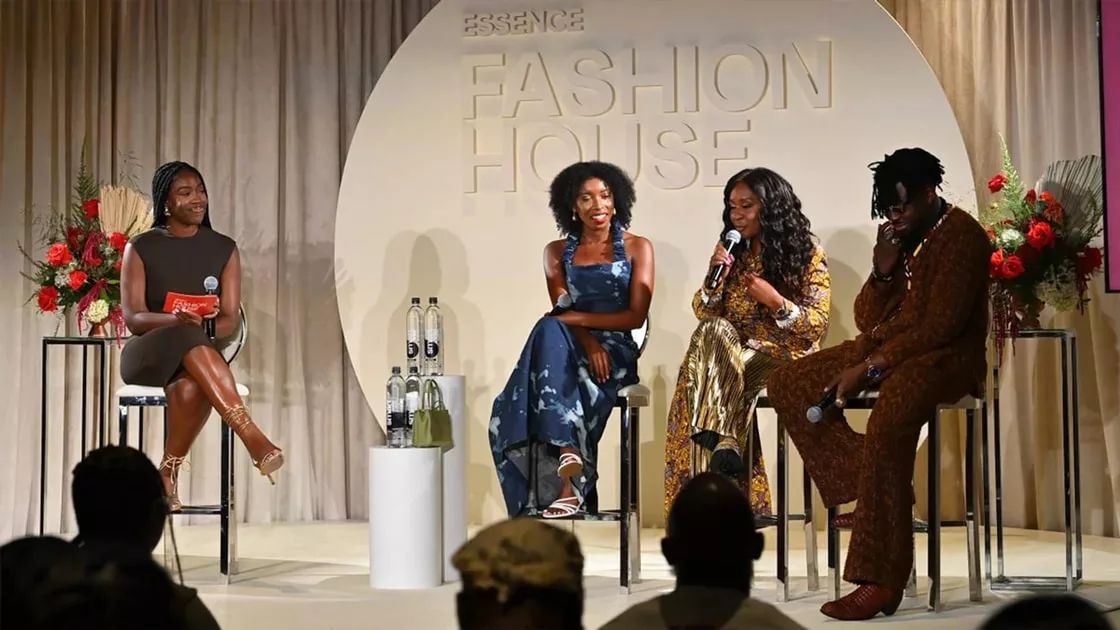
ESSENCE Fashion House: The Ecosystem Of African Fashion

African designers and industry professionals discuss the influence of Africa on fashion globally.

Journalist Nana Agyemang, who is also the CEO of EveryStylishGirl, put together a diverse panel of African designers, industry professionals, and business owners for an ESSENCE Fashion House conversation.
Amira Rasool, the CEO of the wholesale marketplace The Folklore, Barkue Tubman, the Chief of Staff and Diasporic Engagement at Essence Ventures, and Kwaku Bediako, the creator and creative director of the fashion label Chocolate, were all part of the Ecosystem of African Fashion.

They each emphasized the interconnectivity of Africa with the international fashion business during their conversation.

“I feel like it’s so important that we connect,” Tubman said. “That’s part of my responsibility at ESSENCE Ventures, and just really in my life. I think that’s why this all works for me.” “For everything, with each other.
I believe we are aware of our effect on the fashion industry, and connecting the disconnected is what Essence Ventures wants to continue doing.
We’re going to accomplish it via a number of pillars, including economic inclusion, fashion, entertainment, and diaspora. Because I believe that Africa is luxurious, I am a major fan of African luxury.

Bediako emphasized how important it is to link African traditions with those of other continents as well as with those of other civilizations within Africa.
During the discussion, Caroline Wanga, the moderator of We’ve Been Here Before 50 Years of Hip-Hop Fashion, was actually sporting a bespoke Chocolate.
Bright colors and a variety of textures were used throughout the composition.
Rasool is commemorating The Folklore’s fifth anniversary, while Bediako is also marking Chocolate’s tenth anniversary.

Rasool is essential in helping different products gain exposure by securing placements with stores like Nordstrom, Saks, and Bloomingdale’s.

No insult intended, but working with the brands is the most challenging aspect of running our firm, Rasool added. “Because you are creative, your business is sensitive. It’s also the most satisfying aspect, and my journey to South Africa is what actually gave me the idea to found The Folklore.
While I was an undergrad, I had never been there before, and I instantly fell in love with the community.
I’ve worked in the fashion business for some time. I used to work in the media and was familiar with all of the European and American brands, but I was completely ignorant of the South African names at the time.

Content Courtesy of ESSENCE Fashion House & NFH

Kenyan Fashion Designers Protest Textile Waste With Their Designs

Nairobi’s secondhand clothing market serves as both an inspiration and a backdrop for the fashion industry.
When vendors at Gikomba, the biggest flea market in East Africa, begin setting up their goods on low wooden stalls, dawn has barely begun to paint the sky with a gentle gray tinge.
They carefully organize the secondhand clothing they purchase by weight into enormous sealed plastic bundles by category. a heap of denim.
Tennis shoes stacked high. Bras of all colors and sizes are neatly arranged in a row.
Despite the early hour, throngs of people pack the cramped Kenyan market lanes as vendors shout over one another to promote their wares.

When a trader opens a fresh shipment, the tension increases. Shoppers swarm the area looking for “cameras”. “Items that resemble clothing you would see in a magazine or on television. Isichy Shanicky, a 21-year-old designer at the Maisha by Nisria Collective, said, “That needs to be captured on camera.
She effortlessly maneuvers through Gikomba’s mazes by adhering to its unspoken norms, just like millions of other Kenyans do.

“Arrive early. When a fresh product is opened, you should be present, she advised. “Strip off. The vendor will assess your price by looking at you.
Hold onto a piece you like if you see one. Or someone person will seize your priceless discovery.
Because secondhand shopping is so common, it has its own terminology and manners.

A significant portion of the Kenyan economy is devoted to used clothing imported from overseas. They cost the nation $169 million to import in 2021.
Sixty-five thousand individuals are employed by the Gikomba market alone. The environment and the struggling home textile industry, according to critics, are sacrificed in the process.
At Gikomba, Nicholas Kilonzi began his professional life. Following the passing of his father in 2009, the family was unable to support Kilonzi’s tuition costs.
After landing his first job assisting a dealer in used shoes, he eventually saved enough cash to launch his own company, which presently has three employees.

Kilonzi’s profitability has decreased over time along with the quality of the clothing that is imported from abroad.

We find maybe 10 cameras when we open a 62kg (137lb) package, he claimed. “Five years ago, there would have been 40 or 35.”
The non-camera items, which include cheap, torn, or worn-out clothing, are sold for 50 shillings ($0.35) each.
The leftovers are either turned into commercial rugs or dumped along the banks of the Nairobi River, which flows close to Gikomba.
A third of all clothing is made of plastic garbage, which will degrade into contaminating particles for the earth and the ocean.

One effect of the fast fashion business is the colorful mountains of discarded apparel that line the river’s banks. Such scenes are now commonplace in the Global South, far from the glitzy catwalks and brightly lit storefronts of the world’s fashion capitals.

Nairobi Fashion Week’s creative team planned a photo shoot near the trash to expose the social and environmental crimes of the industry. Its Just Fashion campaign, which runs from April to November, includes the photo session.

“We are not attempting to combat used. It gives millions of people access to affordable apparel and work.
To make fashion sustainable, we support informed consumer decisions and legislative regulations.
Idah Garette, an environmental activist and shot participant, remarked that what people buy has an impact.

Idah is wearing an organic silk dress by Deepa Dosaja, a high-end Kenyan designer who is at the forefront of advocating ethical fashion choices, in marketing photographs. The outfit has hand-painted sustainability slogans.
Dosaja declared, “I have noticed a positive shift. “People who once shopped in Dubai or London now take pride in wearing Kenyan clothing.
Not only is ethical fashion better for the environment.
It generates respectable and worthwhile jobs.
Young designers are already reshaping Kenya’s fashion industry and its long-standing, contentious relationship with discarded clothing.
A new fashion house is called Maisha by Nisria. Its designers, who range in age from 21 to 28, produce unique creations using recycled clothing and leftover textiles.

Shopping at places like Gikomba helps them express their creativity and lessens the negative effects of their industry on the environment.

Conde Tausi, a 28-year-old designer, believes that using secondhand began as a need and later evolved into a goal. “You touch a piece, and it speaks to you,” she says. “I didn’t have the funds to purchase materials when I first experimented with my designs.  leftover clothing from her wardrobe. I eventually realized that the wardrobe was cleaner.
And I pondered whether we would be able to accomplish this on a global basis.

Content courtesy Al Jazeera & NFH 

Pageant Politics: Zozi Tunzi Ditches Miss SA After ‘Dress Drama’

Did Zozi Tunzi ditch the Miss SA pageant finale and unfollow them on IG – after being asked to pay for her own dresses?

There are numerous rumors claiming that former Miss SA Zozi Tunzi skipped the pageant’s grand finale due to an argument about her costume expenses.

Zimoja claimed that Tunzi was required to fit into her attire for the pageant reality TV program Crown Chasers.

The 2019 Miss Universe winner Zozi also appears to have unfollowed the competition on Instagram.

Zozi Failed To Attend Miss Sa
While many former Miss South Africa contestants, including Tamryn Green, Cindy Nel, Tansey Coetzee, and Melinda Bam, were present at the pageant’s conclusion on Sunday, August 13, Zozi Tunzi did not.

The former monarch, who hosted the six-part television series Crown Chasers, had a significant role in the finale’s build-up.

It’s interesting to see that Zozi Tunzi didn’t post anything about Miss SA’s crowning.
Additionally, she stopped following the official Instagram account.

Who Is To Blame For The Dress Dispute?
Zimoja claims that Zozi Tunzi was asked to use Crown Chasers to pay for her wardrobe bills.
That was not covered by our agreement, a person who wished to remain nameless informed the publication. I was hired as a stylist for the show, not by Zozi, and now I’m being expected to bill her.
A five-part television series called Crown Chasers gave viewers a behind-the-scenes peek at the contest.
The show’s hosts were Zozi and the judges were Leandie du Randt and Bonang Matheba.

Reply From Miss SA
Tumi Moema, Zozi Tunzi’s manager, reportedly acknowledged the dress issue to Zimoja.
“Zozi has nothing to do with the stylist’s payment,” he declared. We did not agree to that. I’ll discuss it with them.

The South African contacted Miss SA for a formal response. “Zozibini Tunzi is an in-demand personality with a full schedule,” it was stated in a statement.
Other than that, the Miss South Africa Organization is unable to comment on Ms.
Tunzi’s schedule or her use of social media. At every Miss South Africa event, she is, nevertheless, warmly greeted and recognized.

“The Miss South Africa title carries with it a lot of hope, aspirations and most importantly, it enables young women from all backgrounds to showcase the power of what one can achieve with the right mindset.

“This is a showcase of intelligent, passionate, and confident young women who are carving various paths toward success. The SABC remains the home of events of national importance and our logline for S3 is ‘Open Up’.”

“Crown Chasers” will be broadcast weekly starting from Saturday, July 8, in the lead-up to the final event and the crowning of a new Miss South Africa, which will take place at Sun International’s SunBet Arena at Time Square in Pretoria on Sunday, August 13.

Content courtesy of The South African & NFH


Kenyan Fashion: The Independent Zine Honoring Kenyan Designers’ Pulsating Energy

Genuineness does not always entail being responsible or eco-minded, Contrary to popular belief, WAUZINE004, a dynamic digital platform that champions the nexus of fashion, culture, and identity, is on a mission to disprove this.
The pulsating energy of African (note, Kenyan) designers has something significant about the current state of consumer taste, namely the influence of innovative offerings and off-beat aestheticism that brings forth proposals with an avant-garde, distinctive, and vibrant edge.
These designers delve deeply into the fascinating narratives of Kenya’s heritage while blending its relationship with the environments we live in.

The fourth issue of WAUZINE, with the Swahili title KUTOKA NAIROBI (from Nairobi), portrays Nairobi as a city known for its dynamic soul, seamlessly fusing with its rich traditional heritage, transforming into a creative canvas for a plethora of stories that arouse nostalgia and a genuine sense of cultural belonging.

Strong, imposing design: a stunning celebration of both concentration and toil that goes beyond a printed shirt or a suntanned top. It not only represents voices that are both inventive and socially conscious, echoing the pulse of a promising fashion system, but it also perfectly combines tradition, sustainability, and the feverish quest for artistic flare on a worldwide scale.

The fourth edition of the zine, Office describes the work of three Kenyan designers.

Theresia Kyalo
Theresia Kyalo began her career as a lawyer before dipping her toes into the development of distinctive contemporary jewelry. She drew significant influence from antique African jewelry while introducing her aestheticism to the modern day through simple, geometric shapes. Hardy brass is the designer’s material of choice since she wants to keep her line accessible.
A shining moment for the designer came in 2020 when Beyoncé included him on her list of Black creatives. He worked in both digital art and movies.

Yvette Anyango
Designer of Alegohono Yvette Anyango says, “Being featured on the 4th issue of Wauzine has been such an eye-opener for the brand.
It has sparked the urgently required awareness, development, and interest in what African fashion has to offer.
The designer’s collection features a variety of outfits that can be incorporated into a daily wardrobe: neutrals are dominant, and the brand’s guiding principles and ultimate embodiment are drawn from architectural design and include native art and photography.
These straightforward guidelines serve as a design manual for creating clothing with practicality.

Mvoo Wanje
“The history of Kenya is a rich tapestry of customs and civilizations, with an intriguing fusion of African, Western, and Arabic influences. Kenyan culture defies easy categorization; rather, when it comes to artistic endeavors, we have a powerful voice that merits consideration.
Designer Mvoo Wanje of Bonkerz NRB, who established the company in 2011, grew up in the 1990s with little to no media from the continent.
He freely acknowledges the mix of allusions that permeate his clothing “I can say hip hop as a sound and culture heavily influence how I see and create.”

Inspired by the beauty of color and the childlike things in life, the designer cares to share a perspective of Africa that isn’t about the struggle; rather, he’s keen to bring forth energy that translates into utility-heavy pieces that veer towards the functional and the practical with a zingy spirit.

Content courtesy of  Fashion Scouts, Office Magazine & NFH

African Fashion Retailer Produces A Unique Fashion Show At The Karoo Winter Wool Festival

When we talk about fashion shows, we frequently pay more attention to the designers than to the curators who make sure the environment is appropriate for the items being displayed.

A fashion show’s location and production style have a significant impact on how the clothing is highlighted.
The African clothing company Merchants on Long organized a fashion display featuring South African designers at the Karoo Winter Wool Festival.

Designers like Mmuso Maxwell and Lukhanyo Mdingi showcased a true celebration of South African wool and skill at the fashion show, which was centered on sustainability and durability and portrayed a cyclical, sustainable fashion industry where clothing is returned to the source.

The showcase also included designs by Viviers Studio, Luminous Ware, Emelia Dorcas, INKE Knitwear, Fields, Wrapt Knitwear, House of Lucent, and GugubyGugu.
The curator of the show and fashion buyer at Merchants on Long, Sumendra Chetty, was quite clear about the types of designers she sought for the exhibition.

“In choosing the designers, I was quite deliberate. The first requirement was to find designers who had a history of working with the local wool sector; names like Lukhanyo Mdingi and MmusoMaxwell instantly sprang to mind.

“Our definition of luxury is based on durability, recyclable materials, respect for the environment and animals, as well as adhering to fair-trade principles.
“Every designer was required to adhere to this ideal, ensuring that we advanced purposefully. This showcase was identical to what we were presenting in person or online, according to Chetty.

Chetty and her colleagues devised something unexpected instead of the typical runway that we are used to. In order to display the most recent collections from the designers, models strolled beneath the stunning Karoo sky.

The visual storytelling had to have the same effect as the Karoo scenery. I made the decision to create layers to resemble the Karoo sky pretty early on because the trend was already so daring and distinctive.

From the delicate whites and creams of the cirrus clouds through the soft beige and sand of golden hour to colorful blossoms, dusk to blue, and eventually culminating in a starry night.

Content courtesy of IOL & NFH

Kenyan Model Hassan Duba: Celebs Have Popularized Nigerian Fashion

Hassan Duba, a fashion influencer and model from Kenya, has praised Nigerian celebrities for promoting the nation’s fashion industry.
According to her comments to Saturday Beats, “Nigerian celebrities, such as actors, artists, and influencers, have significantly contributed to the globalization of Nigerian fashion.
Their everyday attire as well as their red carpet outfits have inspired many. People have been inspired to be more daring and expressive with their personal styles by their daring fashion choices.

Duba commented that the vivid and varied selection of materials used in African fashion sets it apart from that of other regions.
The vibrant colors, detailed patterns, and distinctive textures of these fabrics, which range from classic prints like Ankara, Kente, and Kitenge to modern interpretations, set African fashion apart.

The cultural traditions and heritage of the continent are also honored by African fashion.
When asked what she thought fashion represented, she responded, “Fashion is a form of self-expression and creativity.
Through the selection of clothing, accessories, and personal grooming, it offers the chance to express one’s uniqueness, personality, and style preferences. It also enables one to express one’s identity, views, and feelings to the outside world.
As it allows us the opportunity to try out new styles, trends, and aesthetics, fashion may be liberating. One can express themselves honestly and with confidence thanks to it.

African celebrities from all over the continent have united in an amazing display of support for influencer Hassan Duba, who was born in Kenya.
The top influencer, who has been dubbed one of the most attractive women in the United Arab Emirates, has won over many hearts with her talent and personality.

Duba, who competed for Miss Universe UAE 2022, has established herself as a major player in the fashion and modeling worlds in addition to making a name for herself in the world of pageants.
Her popularity has quickly surpassed national boundaries after appearing at prominent events including Dubai Fashion Week, New York Fashion Week, and Fashion Week DXB.

Duba’s status as a rising star in the entertainment and fashion industries is further cemented by the outpouring of support from African superstars like Tems, Chanel Ayan, and Lisa Milan, founder of luxury design label Minaroe.
A number of well-known actors, musicians, and celebrities have praised and urged Hassan Dub on social media. Duba’s talent, style, and commitment have been praised by powerful figures in the African entertainment sector from Nigeria to South Africa.

Hassan Duba’s extraordinary journey and accomplishments serve as an example for aspiring influencers and models not only in East Africa but across the entire African continent.
She has gained the respect and affection of both her peers and admirers thanks to her perseverance and dedication to her craft.

The enormous amount of support Duba is getting is proof of the strength of African talent and innovation.
People like Hassan Dub act as ambassadors, highlighting the enormous potential that the entertainment and fashion sectors on the continent hold as the world continues to appreciate and recognize the diversity and depth of African culture.

Hassan Duba stands tall as a beacon of African brilliance in a time when discussions about representation and diversity are at the forefront.
Her transformation from an entertainer to a global influencer and fashion star is proof that young African people with ability, passion, and perseverance can achieve everything they set their minds to.

Content courtesy of Punch , Independent & NFH 


The Designers That Will Be Exhibiting at the Standard Bank Luju Food & Lifestyle Festival Have Been Unveiled.

The Standard Bank Luju Food & Lifestyle Festival will take place as usual, following the success of the MTN Bushfire Festival in Eswatini.
The event is a two-day extravaganza of music, fashion, entertainment, and gastronomic treats.
The theme for this year’s event is “A Return to the African Future,” which will showcase Africa’s natural wealth, beauty, and elegance from the past to the present and into the future.

It’s a sensory trip, a reimagining of our legacy, and a peek at tomorrow’s design advances.
Luju 2023 will commemorate the transformational power of design and the use of fashion to impact future generations, in addition, to live performances by great African artists and a full gastronomic program.

This year’s theme, “African Fashion Folktales,” emphasizes craft mastery, with sustainable materials serving as means for reclaiming ancestral traditions. We reimagine our future by weaving these stories from our history together.
Mbali Temantimandze Kunene, Nomi, House Of Diva, and Ntrentre Couture Creations are among the designers whose designs will be showcased at the Luju Mastercard Runway Show.

“The Design and Craft creatives will be tasked with creating a capsule collection to be presented as part of the Standard Bank Luju Fashion Runway on the Mastercard Stage.”
“Working with local stylists, hair artists, and models, the collective will create a pop-up fashion performance that will be displayed on a regular basis in the Fashion Café Marketplace.”

“The Fashion Café Marketplace is a swarm of creative abundance, offering a wide range of African clothing, accessories, and skin and hair care products.

“Festival goers can find a wide variety of items inspired by African culture and heritage, including colorful apparel, distinctive jewelry, and healthy skincare products.

This market has something for everyone, whether festival-goers want to include natural, plant-based substances into their skincare routine or want to add some bold statement pieces to their outfit.

According to the event’s organizers, festival attendees may shop with assurance knowing that their purchases support small, independent enterprises and showcase the exquisite workmanship of Africa.

Designers will participate in the first market showcase following the fashion show to advertise their off-the-runway collection.
They will carry out this action as part of the Artisanal Incubator Programme for 10 MSMEs, which is sponsored by the European Union and run in collaboration with the International Trade Centre (ITC) Alliance for Action Programme.

On August 4 and 5, the Standard Bank Luju Food & Lifestyle Festival will be held at Malandela’s Farm’s House on Fire. There will be numerous South African musicians performing, including Big Zulu, Lloyiso, Sun-El Musician, Zo Modiga, and more.

About The Standard Bank Luju Food & Lifestyle Festival
A family-friendly feast of culinary exploits, high-end fashion, premium wine, and whiskey showcases fine music and wholesome entertainment.

Through culinary showcases by celebrity chefs, and fabulous fashion designs inspired by the Luju ethos “A Return to the African Future”, the festival celebrates the sophistication and elegance of African vintage style, creative design, and delicacies. Come and Eat, Sway, Love, and rejoice in our heritage and culture, in all its afro-futuristic boldness.

The Standard Bank Luju Food & Lifestyle Festival is proudly brought to you by House On Fire, with generous support from Standard Bank Eswatini.

Content courtesy of IOL , The Standard Bank Luju Food & Lifestyle Festival & NFH


The 2023 Schedule for Lagos Fashion Week is Announced

Lagos will once again be at the forefront of connecting with the global fashion community and honoring the craftsmanship of Africa and its diaspora during the 12th iteration of Lagos Fashion Week, which is scheduled to take place from October 26 to 29 of 2023.

Within Africa’s constantly changing fashion scene, Lagos Fashion Week occupies a key role. It continues to guide the continent’s fashion industry toward a conscious future that cuts across boundaries, strengthens communities, and has a significant socioeconomic impact.

Lagos Fashion Week is devoted to presenting the rich creativity and artistry that have come to define African fashion, building on its journey of more than ten years. As proven by various ground-breaking partnerships formed over the years, collaboration is at the heart of its vision for the future of fashion, nurturing alliances that open up novel avenues and produce one-of-a-kind chances.

The event encourages co-creation, welcomes varied talent, and deftly combines innovation and tradition to create designs that honor cultural legacy while embracing the digital world. Lagos Fashion Week also champions community strength through fostering talent, elevating voices, and igniting change in the fashion industry.

In the #LagosFW Tents and other locations throughout the vivacious city of Lagos, Lagos Fashion Week 2023 will return with Runway Shows and Presentations showcasing new season collections from designers.
The Nigerian and Pan-African industries, as well as other sectors, will be the focus of the Fashion Business Series. With seminars and master lectures, the Visual Makers Fellowship was established to assist aspiring filmmakers and photographers.
Created with the goal of fostering fresh dialogue and intellectual interaction regarding sustainability in African design, Swap Shop After parties are a chance to explore Lagos’ nightlife and network with some of Africa’s best creatives in a laid-back setting.
XRETAIL is a tailored shopping experience across key cities in Africa. LagosFW Showrooms provide you access to some of your favorite fashion companies.

Lagos Fashion Week offers Green Access in keeping with its commitment to facilitating the growth of the regional manufacturing economy, fostering impactful conversations, and cultivating young talent. Until August 23, 2023, this yearly talent discovery platform will accept applications from designers in Nigeria.
This season’s subject is “Standing The Test of Time,” and the Green Access program seeks to identify five young Nigerian designers who place a strong emphasis on sustainability and the creative use of waste materials.

A fashion accelerator program called Green Access encourages the recommitment of resource efficiency, biodegradability, longevity, and recyclability as guiding principles for fashion design and production.

Green Access has been highlighting fashion businesses that are changing their business models and implementing measures to support environmentally, socially, and ethically responsible production processes since its start in 2018.

The OR Foundation awarded Themba Shezi (Heru Shezi, South Africa) and Lu Adesola (Lul’la House, Nigeria) financial support in the amount of $10,000 USD following the successful completion of the Green Access 2022 program. The funding was given out to help the recipients’ respective brands grow and advance.

They were chosen for the funding based on their deep awareness of and dedication to researching the idea of circular fashion, as well as the incorporation of pre-existing materials into their design processes, such as textiles, clothing, or waste from other industries.
The OR Foundation, a 501(C)(3) public charity located in the USA, has been operating in Ghana since 2009.

Its primary goal is to find and support alternatives to the dominant fashion model. The foundation’s activities center on the confluence of environmental justice, educational advancement, and fashion design.
The OR Foundation perfectly complements the aims and ideals of Lagos Fashion Week’s Green Access program by promoting ecological prosperity and developing a deeper relationship with fashion that goes beyond mere consumerism.

The OR Foundation and Lagos Fashion Week agree that sustainable fashion has the power to spark good change and move the industry toward a future that is more responsible and mindful.
Emerging designers have the ability to have a big effect and support a more circular and sustainable fashion industry thanks to the Green Access platform.

#LagosFW Important Dates:

  1. Green Access Applications Open: 25th July – 23rd August 2023 | Apply HERE
  2. Runway Shows: 26th – 29th October 2023

For more information regarding Lagos Fashion Week 2023, kindly visit lagosfashionweek.ng or follow their Instagram page @lagosfashionweekofficial.

Content courtesy Lagos Fashion Week, Culture Custodian & NFH


African Designers and Brands To Know About Now

When it comes to fashion, Africa is a continent with no shortage of ability.
While individuals like Virgil Abloh stand out as some of the most significant designers of our generation, the industry is home to a large number of creative people. Designers from throughout the continent are coming up with new textiles, patterns, and textures to create stunning clothing for consumers around the world. The entire globe is enthralled watching.

Others in South Africa are embracing natural components to redesign everyday clothing, while many Ghanaian designers are eschewing traditional wax cloth and kente clothes.

Additionally, there has been a surge of environmentally conscious designers that reuse deadstock materials to create brand-new products. Former Balenciaga employee Bobby Kolade founded Return to Sender in 2022 with the goal of bringing Uganda’s textile sector back to its pre-mid 1970s apex, when more cotton was processed than exported.

Designers from the United States, including Anifa Mvuemba of Hanifa, are doing important fashion exhibits in unusual locations like Washington, DC. “I’m purposeful. She said to Teen Vogue in 2021, “I like doing things my way and I dislike conforming, being put in a box.
“I honestly find it unsettling. I stayed loyal to myself and pushed myself with this performance in D.C. The result was astounding.

African fashion designers are emerging both on the continent and in the diaspora.
Togo-born Jacques Agbobly received a 2019 CFDA Scholarship and attended Parsons. Born in Austria of Nigerian parents, Kenneth Ize is a finalist for the 2019 LVMH Prize.
And Maram Aboul Enein, who later went on to work for Pierre Balmain, Zac Posen, and Oscar De La Renta, fled Egypt for Canada as a young girl.

Algeria
Ilyes Ouali won “Fashion Star Arabia” in 2019 and takes heavy inspiration from the glitz and glamour of the ’70s in his recent work.

Angola
Fashion designer and criminologist Nadir Tati uses fashion as a means of celebrating Angolan womanhood and promoting a culture of peace.

Benin
With his brand Allëdjo, Kassim Lassissi aims to channel all that he has encountered while traveling across the world, into sustainable fashion and style.

Botswana
From shining gold bodycon dresses to floor-length bridal gowns, DihDah offers a range of striking pieces.

Burkina Faso
Pathé’O has designed head-turning garments since the ’70s, dressing African leaders such as Nelson Mandela.

Burundi
Content creator, stylist, and entrepreneur Juan Nsabiye crafts bespoke suits, with a focus on elegance for all genders.

Cabo Verde
Stylist-turned-designer Marvin Lima uses his brand Virtuoso to recognize African videographers, photographers, makeup artists, and models.

Cameroon
With a background in environmental engineering, Liz Ngwane creates both upcycled and one-of-a-kind garments under her slow-fashion brand Margo’s Mode.

Central African Republic
O’poma Designs founder Olga Nganzi Samba-Pamza incorporates African kitenge fabrics into her clothes, which often teem with colorful hues.

Chad
During the height of the COVID-19 pandemic, Jonas Berassengar sewed masks for members of his community, to extend the accessibility of protective measures.

Comoros
Sakina M’sa fuses her interests in contemporary art, dance, and philosophy into her art direction and fashion design work.

Congo
“For women without limits” is Hanifa’s motto, which founder Anifa Mvuemba furthers through increased access to shows as well as inclusive sizing and model casting.

Cote d’Ivoire
Loza Maléombho fuses contemporary and traditional silhouettes through footwear, accessories, and made-to-order garments with gold accents.

DRC
Designer and creative director behind Moulandzaou, Aton Tsiba creates genderless clothes with loose form and fluorescent color palettes.

Djibouti
Yanie Ayoun draws inspiration from her mother and designs for the next generation of Djiboutian youth.

Egypt
Maram Aboul Enein reflects on her own spiritual journey with the brand MARAM and plays with texture through sequins, ruffles, and electric colorways.

Equatorial Guinea
Visionary Society founder Diosdado Sima draws from his early interests in typography and streetwear to create a brand centered on community.

Eritrea
Former costume designer and stylist Selam Fessahaye launched her brand in 2018 and features gilded embroidery and beading in recent work.

Eswatini
For her label Mamakatessa, Temahlubi Dlamin uses silks and tulles of every shade to make gowns for a plethora of occasions.

Ethiopia
Maisha Marshall-Ende’s label Lehwatch explores cultural exchange, as its name translates to, and uses Ethiopian fabrics to create garments inspired by her move to Canada.

Gabon
Teddy Ondo Ella’s label draws inspiration from Gabonese culture and dress, utilizing traditional pieces such as sarong wraps paired with bold patterns.

Gambia
Masaneh Badjie’s dresses are rich with detail, including corset-style boning, appliqué, and crystal beading.

Ghana
Free the Youth began in 2013 by Jonathan Coffie, Winfred Mensah, Richard Ormano, and Kelly Foli; it has grown beyond its initial purpose of documenting Ghanaian streetwear and now encapsulates the brand and organization.

Guinea
Mariama Camara is a designer and humanitarian, whose interest in handmade textiles began at a young age when she watched her family design and dye prints.

Guinea-Bissau
Armando Cabral began working in the fashion industry as a model and shifted to design in 2009 as his continued interests in footwear and luxury clothing grew.

Kenya
Akiba Studios fuses functionality and playfulness through whimsical motifs and pieces with a street-style twist.

Lesotho
Creative director and fashion designer Thabo Makhetha offers luxury coats, jackets, and capes inspired by Basotho blankets.

Liberia
Archel Bernard began her sewing factory with an all-woman staff in 2016, to help those impacted by the Ebola epidemic; after the factory’s success, she opened her ethical fashion store, Bombchel, four years later in Atlanta.

Libya
Through minimalistic and geometric pieces, designer Ibrahim Shebani allows Born in Exile’s ensembles to speak for themselves.

Madagascar
After studying fashion in Paris, Eric Raisina debuted his work in the mid-2000s, which focuses on tactility and color.

Malawi
Award-winning entrepreneur Lilly Alfonso’s penchant for fashion design traces itself back to her youth when she would upcycle and reinvent her mother’s old clothing.

Mali
Lamine Kouyaté’s Xuly. Bët repurposes deadstock fabrics in his garments, a practice pulled from his mother and grandmother who would reshape old clothes for him and his siblings as children.

Mauritania
Kadiata Diallo of Niuku fuses form and function with hand-painted dresses and suits.

Mauritius
Fabien Fauzou is a designer and seamstress who specializes in geometric and vibrant dresses.

Morocco
Doum offers a range of bags, from totes to cross bodies, with summery, woven elements.

Mozambique
From a tracksuit touting the word “fearless” to sleek little black dresses, Taibo Bacar offers customers a range of garments and accessories.

Namibia
Melisa Poulton, founder of House of Poulton, describes her label as powerful, dramatic, and bold, and she aims to bring strength to her wearers.

Niger
Referred to as the “magician of the desert,” Alphadi debuted his label in the mid-1980s and has crafted highly-detailed bustiers, maxi skirts, and floor-length dresses since.

Nigeria
Kenneth Ize’s unisex work features technicolor hues and traditional Aso-Oke fabrics on oversized tunics, waistcoats, and dresses.

Rwanda
The Mysteries plays with extreme silhouettes and textiles in its unconventional sets and individual pieces.

Sao Tome and Principe
D&D Clothing offers both ready-to-wear and custom ensembles, donning patterns that range from animal print to neon patchwork.

Senegal
Contemporary lifestyle brand Diarrablu innovates tradition through its inclusive clothing, jewelry, ceramics, and artwork.

Seychelles
Johanna Didon launched her brand Katiti in 2017, which focuses on classic styles with edgy twists, although she had been sewing clothes since she was 12.

Sierra Leone
Sai Sankoh looks to retro and vintage clothing for inspiration as well as pieces in her own wardrobe; her work brings luxury to anyone and everyone.

Somalia
Through a combined interest in jewelry and tailoring, Omar Munie began his award-winning work as a bag designer in the early 2010s.

South Africa
Swim, surf, and beachwear brand Bantu Wax is making waves with its graphics-driven apparel.

Sudan
Yousra Elsadig aims to dismantle stereotypes and sustainability through her work with the brand Boutique de Nana.

South Sudan
Activist, doctor, and designer multi-hyphenate Mayada Adil use clothes to empower women refugees and honor diplomacy.

Tanzania
Through her brand Naledi, designer Kemi Kalikawe celebrates spunk and youthfulness and advocates for women’s equality at the intersections of fashion and technology.

Togo
Textile artist and designer Jacques Agbobly launched their made-to-order knitwear label, Black Boy Knits, inspired by the joy they saw as a child from customers of tailors and seamstresses in Togo.

Tunisia
Appearing on Project Runway Middle East, Malek Gheni juxtaposes maximalist bling with simple and geometric pieces.

Uganda
Bobby Kolade’s brand Buzigahill aims to combat Uganda’s secondhand clothing crisis, by making efforts to return its textile industry to the success it faced in the late twentieth century.

Zambia
As an entrepreneur and founder of Debbie Chu, Deborah Chuma sees her label as a community, rather than a fashion design brand.

Zimbabwe
Vanhu Vamwe has created a community of macramé weavers and celebrates handmade objects and craftsmanship.


Content courtesy of Teen Vogue & NFH


South African Fashion Designers Revive the Detritus of Western Fashion.

Khumo Morojele and Klein Muis, two aspiring fashion designers from South Africa, spend hours searching a secondhand street market in Johannesburg for clothing.
The pair then upcycles what they discover into apparel or accessories that, in their opinion, show African style in a distinctive way.

Unlike recycling, which typically entails disassembling the original material and turning it into something else, upcycling refers to reusing an object in a novel way without compromising the material it was built of.

The two are currently working on a project called “Dunusa: Life of a Garment,” in which they source second-hand clothing that is frequently shipped from European nations to Africa and then disassembled and reconstructed into avant-garde and abstract apparel.

On July 14–16, the collection will be on display at the “Forecast Forum,” an international arts festival in Berlin where budding artists can find mentorship.

According to the 22-year-old Mr. Muis, “The question that we are trying to answer with the project is really the disparity between the north and the south… how certain parts of Africa become dumping grounds for European countries.”

The two work together as well as with other African artists. They are collaborating with a shoemaker in Ghana on a project to transform used soccer boots into sandals that honor both African and European passion for the game.

Because we value and truly connect with the possessions we own, it is consistently emphasized in our culture that we don’t squander anything.

According to Mr. Morojele, a 20-year-old, ” We kind of want to represent it and transcend that in our clothing.

Content courtesy of  Business World & NFH


African Textiles and Cutting-edge Technology Revolutionize the Fashion Industry, Thanks to a Nigerian Consultant

Felix Adu, a Nigerian-born fashion consultant working in Sweden, is creating waves by combining African materials into mainstream fashion, a revolutionary move that has shocked the fashion world.

Not content with that, Adu is also revolutionizing the fashion sector by fusing AI, NFTs, and cryptocurrency tokens into his line of clothing.
Adu is revolutionizing the world of fashion with his creative methods and dedication to exhibiting the splendor of African culture.
Adu’s concept is the result of his abiding love for his Nigerian roots and his ambition to make African textiles more prominent in the world of fashion.

Adu seeks to overthrow the fashion industry’s predominance of Western aesthetics by recognizing the wide range and exceptional craftsmanship found in African materials.
Adu honors the rich diversity and cultural legacy of Africa by combining traditional African textiles into his creations, which also promotes awareness of underappreciated artistic genres.

The way that Adu has used artificial intelligence (AI) in his fashion line is one of the main factors contributing to his success.
Adu improves his design process by utilizing AI technologies, making it possible to produce fashion items more quickly and accurately.

Adu can push the envelope and explore with daring patterns, colors, and styles because of the combination of artificial intelligence and artistic vision.

African textiles and artificial intelligence work together to produce a distinctive blend that appeals to fashion fans around.

The innovative mindset of Adu goes beyond only design. He enters the world of digital art by using crypto tokens and non-fungible tokens (NFTs) to give his fashion business a new level of worth.
Adu gives collectors the chance to own unique digital copies of his creations by minting NFTs of his limited-edition clothing.

Furthermore, Adu has embraced the possibilities of cryptocurrencies and crypto tokens, allowing his consumers to use digital currencies to make transactions and upending established payment systems.
African textiles and the thriving fashion business on the continent are now receiving much-needed attention thanks to Felix Adu’s trailblazing initiatives, which have won him international renown.

Adu is challenging perceptions and changing international standards of beauty by infusing African aesthetics into the mainstream fashion narrative. His brand is at the vanguard of technological development in the fashion business thanks to his inventive use of AI, NFTs, and crypto tokens.
Along with profoundly altering Felix Adu’s personal life, his move from Nigeria to Sweden had a significant effect on the fashion industry.

He stands out as a true innovator in the business thanks to his dedication to exhibiting the exquisiteness of African textiles and his incorporation of AI, NFTs, and crypto tokens.

As Adu continues to revolutionize fashion, his work inspires young fashion designers throughout the world by demonstrating that creativity, cultural celebration, and cutting-edge technology can all coexist on the catwalk.

Content courtesy of Van Guard & NFH


Ad