For too long, fashion’s gatekeepers in Western nations have largely ignored the abundance of ideas and creativity brimming out of African countries, where designers have been toiling away without recognition outside of their local communities.
While there is still a ways to go, there has been a slow but steady influx of platforms geared toward exposing these talents to a wider audience. From online concept store The Folklore, which distributes luxury and emerging designer brands from Africa, to Orange Mentorship, an initiative that provides mentorship of young fashion entrepreneurs in Africa, many of the continent’s designers are finally starting to get their due.
Among the most recent success stories are arguably Thebe Magugu, the designer who grew up in the city of Kimberley in South Africa’s Northern Cape and just launched his first e-commerce shop, and Kenneth Ize, whose reinterpretation of traditional West African fabrics and Nigerian craft made its official debut this year at Paris Fashion Week. Notably, both designers were finalists of last year’s LVMH Prize, with Magugu scooping up the top award.
Still, while there have been several regional fashion weeks in recent years, they have yet to attract the kind of global attention paid to the four main capitals. (It was at Arise Fashion Week in Lagos two years ago where Naomi Campbell notably called for there to be an African edition of Vogue.) Even smaller showcases held in predominantly white cities like Copenhagen and Sydney have drawn a significant amount international guests.
Recognizing the need for more structures in place to support emerging African fashion talent, the Ethical Fashion Initiative recently announced the launch of its first Accelerator Programme, which targets existing fashion brands producing in Africa who require additional support to accelerate their business in the global marketplace to become investment ready. The organization selected five designers to participate in the platform: REIGN, Margaux Wong, Lukhanyo Mdingi, WUMAN and Jiamini.
The five talents were picked out of a pool of 250 applicants by a judging panel comprising of Nigerian actress Dakore Egbuson-Akande, Japanese retail magnate Hirofumi Kurino and creative consultant Susi Billingsley. As part of their selection, the designers will get to reveal their latest collections in 2021 during Pitti Uomo, the bi-annual international menswear trade show where guest designers such as Telfar, Jil Sander and Givenchy have all shown in the past.
Ahead of their debut on the global stage next year, PAPER caught up with the five winning designers to get their thoughts on the state of the African fashion industry, how their heritage and culture influences their work, and what they’re most excited about as they get ready to show their work on an international platform.
Margaux Wong
Margaux Rusita is a Guyanese/Burundian designer with more than 18 years of experience based in Burundi, East Africa. Her company, Margaux Wong, is known for its signature technique of turning rare cow horn and brass into luxurious and wearable art.
The creative director works with her team to produce distinguished artisan jewelry using tedious traditional techniques, and she’s also mentored hundreds of young designers over the last 10 years in her home country.
How has your African heritage influenced your creativity and design approach?
Having spent the last 11 years living and working on the continent has morphed my Afro-Caribbean decent and love of Africa and all its colors very well with my work and expression. I have been able to immerse myself in the culture, traditions, history and traditional jewelry making techniques, which I have been able to observe and learn throughout the years. It is clear that preserving certain techniques is quite difficult especially in the world of fast fashion, which is why we hold on to them. It is very important to us to maintain the integrity of culture for posterity while engaging with contemporary ideas for design and expression.
What have been some of the highlights and challenges of being based and producing in your country?
Burundi has been known as being a war-torn, poverty-stricken country for many years. We are very pleased that in a very small way, we have been able to change that narrative by telling positive stories about what we do and actually showcasing the amazing work that we have been doing at shows on at least four continents.
Winning the trust and respect of my male employees has taken many years of hard work and is still a challenge to some degree, as they are used to being the leaders in their homes, jobs, and communities. I give daily support and encouragement, knowing myself how capable our artisans are but also acknowledging the trauma background of war and near death from which they came.
We have also had challenges with inefficient banking systems as well as shipping challenges due to our landlocked position on the continent. With the successes and challenges, however, we have been able to come this far. Building my brand and business in Burundi has been a major stepping stone for me as a designer, business owner, and innovator. There is no doubt about that.
“It is very important to us to maintain the integrity of culture for posterity while engaging with contemporary ideas for design and expression.”
What does it mean for you to get the support of a platform like the EFI?
As a designer, I can’t say that I have chased this kind of recognition much over the years. My focus has been to work on my craft and hopefully over time, have my work speak for itself. I think my attraction to EFI went way beyond being recognized. I saw an organization that was offering much needed mentorship, guidance, technical support, and validation for all the years of hard work I had previously put in.
Now that I am benefiting from their support, I feel further validated as an artist. I am further convinced that I am on the right track and feel encouraged that my art needs to be shared with the world, not only as my art but as a boost to all those with whom I have worked all these years.
What are some of the ways African fashion designers can be supported so that they can become global businesses?
African designers, like any designer from every background, require lots of support in order to become globally successful businesses. I think our proximity to global competitors, peers, platforms, and experienced professional mentors is a major challenge.
What the EFI has done by creating the bridges we need to connect with the rest of Africa and the Western fashion world is revolutionary and exactly what we needed as an answer to this challenge. African designers also need to be connected to African investors and mentors who are immersed in the continent and can assist in strengthening trade relationships and cultural exchange within the continent. This involvement can help to solidify our confidence in our ability to enter any room on the global platform and exist as people who are able to compete with competence, confidence, and drive.
WUMAN
Ekwerike Chukwuma is a Nigerian fashion designer/artist who launched the men’s and womenswear brand WUMAN in 2013. He cites the female anatomy as a perennial source of inspiration, which he first obtained from his medical school studies.
The cross-disciplinary areas of architecture, poetry, and geometry inform his contemporary storytelling approach to design while staying true to his African heritage and its unique perspective across the global fashion industry.
How has your African heritage influenced your creativity and design approach?
My heritage and culture have always influenced my design thinking and process. I feel the pulse of Africa, she is a great woman who is dear to me.
The beauty, rich culture, history, and diversity are all elements that form the core of my design process. My works tell stories inspired by my existence in Africa, stories that stimulate you to further see, understand, and love Africa.
What have been some of the highlights and challenges of being based and producing in your country?
One of my highlights of being based and producing in Nigeria is the privilege of learning to work and grow with the resources available. I have also had access to the rich heritage of craft and skills available within my country. I have also had a nearness with my culture firsthand. The challenges faced here include funding, inadequacies in manufacturing, a bit of lack of technical know-how and labor force, economic instabilities, power supply as well as infrastructural deficiencies.
“My works tell stories inspired by my existence in Africa, stories that stimulate you to further see, understand, and love Africa.”
What does it mean for you to get the support of a platform like the EFI?
It means a lot to me and my brand. I see this as a great step in the right direction. The EFI is a reputable organization and selecting me for this great opportunity further amplifies my brand in a bid to grow and succeed both here in Africa and globally.
What are some of the ways African fashion designers can be supported so that they can become global businesses?
African fashion designers can be supported to excel globally through more training and education, access to more developmental programs like the EFI accelerator, platforms that give them more visibility, support in manufacturing, and funding.
Lukhanyo Mdingi
Hailing from a small coastal town in the Eastern Cape of South Africa, Lukhanyo Mdingi describes his design aesthetic as having a “languid sensibility.” The Cape Peninsula University graduate participated in Pitti Uomo’s Fall 2017 Generation Africa in Florence initiative that gave him his first taste of international exposure.
The cross-cultural references help inform Mdingi’s approach, which uses theory and research to create timeless essentials that are refined each season. “Our intention is to collectively create a body of work that has a sense of soulfulness to it, work that is steady, solid, and strong,” he says.
How has your African heritage influenced your creativity and design approach?
Immensely. I think that this is something that is intrinsic to so many artisans and designers. I believe that our diverse and unique heritage is something that is grounded and rooted in the spirit of love. Community is what binds our lineage and culture, celebrating and bringing this within our work allows us to collaborate and celebrate all that we bring to the table.
What have been some of the highlights and challenges of being based and producing in your country?
The highlight is always celebrating the moment this is done solely when all parties involved have put in the work, time, and consideration of their individual roles. Collaboration is so important to us, when you are able to witness the steady and seamless growth of your ally then see them reach their potential, it’s that moment that becomes a highlight, that is priceless.
The challenging aspects, in any career, are finding the people that are aligned with our vision as much as you are aligned with there’s, identifying the intentions and the precision that you envision, and making sure that there are parallels between all involved whichever project you choose to embark on.
“Community is what binds our lineage and culture.”
What does it mean for you to get the support of a platform like the EFI?
It feels like the natural step. The nuances between the EFI and our label are parallel. The importance of craft, collaboration, and considered design is the premise of both entities. What the Accelerator Programme has done is yield our label and give it the platform for our narrative to be seen and heard.
Presenting the new body of work during PITTI UOMO is a space that raises the bar.
What are some of the ways African fashion designers can be supported so that they can become global businesses?
I think it’s simple. It’s continuing to provide platforms such as the EFI accelerator programme to tell our narratives.
Jiamini
Kenyan-based accessories brand Jiamini (meaning “belief in yourself” in Swahili), known for its durable, hand-beaded embroidery, turns traditional pieces into contemporary jewelry. The brand promotes sustainable development solutions while being influenced by African techniques and craftsmanship. Among its company missions is to help local communities rise above poverty through economic empowerment.
How has your African heritage influenced your creativity and design approach?
The diversity of African culture and creativity has always been the foundation of our brand, closely examining the craftsmanship, heritage, and traditional approach used by our forefathers, which have been a strong influence in our designs. Our African heritage has enabled us to communicate an authentic expression of the past, present and future, through design.
What have been some of the highlights and challenges of being based and producing in your country?
Having the opportunity to produce in Kenya enables us to not only create employment but to share, learn and implement traditional skills, knowledge, and techniques, from vast local communities used in production.
“Our African heritage has enabled us to communicate an authentic expression of the past, present, and future, through design.”
What does it mean for you to get the support of a platform like the EFI?
This opportunity couldn’t have come at a better time. A time when the fashion industry in Africa has witnessed tremendous growth in recent years and the global demand and discussion on African-inspired fashion are on the rise.
Getting recognition from the EFI accelerator program and being able to present at Pitti Connect gives us a platform to tell our authentic rich story through design, as well as show the world the quality, richness, and luxury that Africa is capable of developing and producing.
What are some of the ways African fashion designers can be supported so that they can become global businesses?
A great way to support African fashion brands would be through meaningful collaboration and skill transfer programs with already established international brands.
REIGN
Sipho Mbuto and Ben Nozo first met in 2015 as students at the Durban University of Technology in South Africa. They often worked together on class projects where they exchanged ideas and fashion concepts, not knowing that upon graduating they’d team up to create REIGN, which they describe as a brand that “narrates African culture reimagined with traces of eastern and western influences.”
The duo says they constantly enroll in fashion learning programs to be mentored while also mentoring others by engaging in tutorials and workshops.
How has your African heritage influenced your creativity and design approach?
Growing up in the small town of Port Shepstone in Kwa Zulu Natal. It was a beautiful town, however, we had no access to art and cultural infrastructure or creative media. We were at least fortunate to grow up in a family of artisans who were able to influence our perspective and development.
They are an integral part of our drive-in working with arts and crafts. Even listening to stories of their youth while crafting these unique items, made us think differently about creativity and gender as a Zulu man. Specifically how there are certain roles individuals play in the culture of the concerning family clan.
What have been some of the highlights and challenges of being based and producing in your country?
Textiles there are still many challenges for African designers in Africa, one of them being the Chinese domination of the textile industry, such as the unavailability of fabrics, even the ones that are produced locally are created using imported equipment from Asia and Eastern Europe. Not enough funds countless people with incredible ideas languish because they are not able to access the necessary funds to enter the marketplace.
Fashion is a business where you need money in every step, to make quality designs, to market them, and promote them. Lack of accelerator and mentorship programs Industry-related education is another major challenge and if the government doesn’t see a value or a need for the luxury fashion industry locally, it becomes difficult for us to convince the international market of our existence in Africa as mostly we are reliant on help from abroad.
Production and lack of good manufacturers Most African brands are small operations, with no production capacity to supply large orders. Scaling up is hard, given electricity shortages and other manufacturing glitches that come with producing in a developing country. Getting an opportunity to work with our chosen team of people and to learn and grow with them.
“People rarely know who contributes to the growth of the industry outside tokenized representation or engagement in the African contemporary conversation.”
What does it mean for you to get the support of a platform like the EFI?
It’s an exciting opportunity for us as a growing brand as it provides a chance to market our brand to an international market. Gaining a better understanding of the business of fashion and also learning about the different distribution channels of supply chains. Working together with artisans, understanding the inspiring stories behind their craft, motivates us to look deeper into sustainability and producing ethically also.
What are some of the ways African fashion designers can be supported so that they can become global businesses?
Working together with our government on setting up more legislations, policies, and fashion laws to favor African fashion designers by the government would definitely help to improve the African economy while making our fashion brands globally recognized.
Creating efficient distribution channels for designers distribution is usually a challenge for designers. Most designers cannot fully control the distribution of their clothes, having this distribution platform in place can eliminate cost, time, and anxiety in most fashion businesses. Including disadvantaged designers in the fashion conversation, graduates and emerging creatives, stylists, and directors.
People rarely know who contributes to the growth of the industry outside tokenized representation or engagement in the African contemporary conversation. Our own fashion channels are inundated with European or western content.
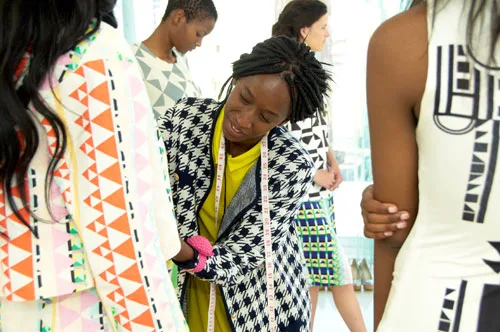
Photos courtesy of Ethical Fashion Initiative
Content courtesy of Paper & Nairobi fashion hub