Sunday 19th of April 2026

Nairobi, Kenya

Introducing Strat Bridal: a Celebration of Timeless Elegance And Exclusivity

An illustrious retailer of high-end wedding fashion, Strat Wedding, is thrilled to reach a key milestone as they commemorate their five-year journey in creating unique bridal experiences.
Since its inception, Strat Bridal has symbolized festivity and elegance by providing an unrivaled variety of lavish bridal gowns that have been painstakingly sourced from internationally famous wedding designers who have walked illustrious fashion runways all over the world.

The brand has had the distinct honor of working with luminaries in the fashion industry, such as Michael Cinco, Alonuko, and Safir Paris, as the exclusive stockist of prestigious brands like Pollardi Fashion Group, Vladiyan Royal, Ida Torez, Oksana Mukha, Daria Karlozi, and Anna Sposa. For their prized brides, these alliances provide a level of quality that is simply unsurpassed.

In celebration of their fifth anniversary, Strat Bridal moves to a larger, improved premises, starting an exciting new chapter.
Within the TMT Atrium building in Bukoto, Kampala, is their new residence, Uganda brings our superior goods and services even nearer to their discriminating customers/clientele.

This historic event also marks the launch of a new brand identity, complete with the much-anticipated release of their limited-edition collection and a new logo for the prestigious 2024 Barcelona Bridal Week.
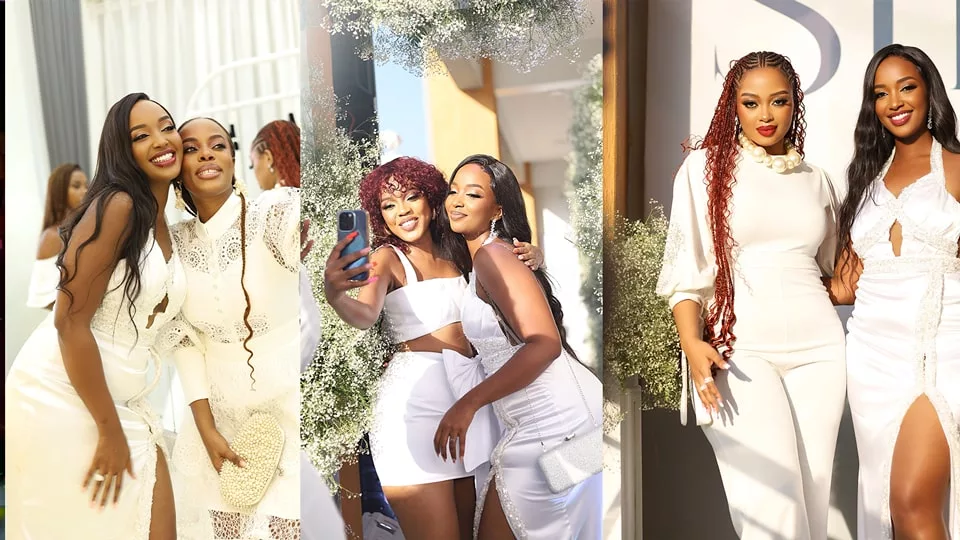
A glittering White Glam occasion, the Grand Opening event was attended by only invitees, including Uganda’s most prestigious and powerful fashion industry Personas and figures.

Tracy Kakuru Otatiina, the company’s founder, expressed her happiness by saying, “It has been a dream come true to lead the development of an opulent wedding shop that shows some of the most prestigious bridal brands in the world in the East African region.
To place our brand at the forefront of modernity and excitement for our brides, I have had the honor of immersing myself in the bridal industry over the past five years, developing partnerships with prestigious designers, and going to international bridal fashion events.

I have a great love for brides, am greatly inspired by bridal fashion, and cherish the important part we play in each bride’s individual wedding journey.

“I am delighted to introduce our new site at TMT Atrium, Bukoto, Kampala, an expansive yet personal room painstakingly constructed to inspire brides to radiate confidence and grace on their big day.”

Content courtesy of Gloria Haguma & NFH 


During the 5-year Anniversary Masterclass, Monalisa Umutoni Offers Beauty Advice to Students

This past Sunday, September 10, 2023, at the Activate Body Therapy Health Club in Kampala, the fifth iteration of the highly sought Mona Masterclass, a beauty extravaganza that every makeup fan dreams of attending, came to a dazzling close.
A new generation of cosmetics enthusiasts emerged in a stunning exhibition of talent and artistry, all taught by Mona and prepared to rule the beauty industry.
This masterclass, which lasted for two exciting days, was very different from the conventional YouTube beauty instructions.

The excited students set out on an illuminating trip through a wide range of elevating sessions that addressed every aspect of beauty, from the finer points of skincare to the most unique and advanced makeup methods.

These were the kinds of insider information that are only shared by experts in the field.
Students were instructed by a prominent group of facilitators, including Monalisa Umutoni, who helped them not only hone their skills but also discover how to transform their passion into a successful business. Bhavya Kalsi, in particular, dug into the subtleties of personal branding and social media marketing, giving these aspiring artists the skills they need to succeed in the digital age.
Thanks to Vicland, the champagne was flowing, and the students were enjoying themselves while studying.

Imagine attending a small class of 50 cosmetics enthusiasts who are all eagerly soaking up every nugget of knowledge from these great teachers. Their creative blank slate?

The students were able to put their newly acquired talents to use on the beautiful faces of models Nkwanzi and Bhavya, who kindly provided their faces as a canvas for the students to work on.
There is more, though.
Participants received more than simply a wealth of new information and insider advice.
They didn’t; instead, they took home a goodie bag filled to the brim with luxurious beauty goodies.
Among these coveted items were the recently released Mona Magic Mist, a collection of premium brushes, opulent goods from Zaron Cosmetics, a skincare line from Nigeria, Bio Balance essentials, the irresistibly stylish Dapper by Rach lipsticks, and chic Khwezi Beauty headbands, to name a few.
These lucky attendees undoubtedly left with their hearts full of beautiful finds and bags brimming with goodies.

As students began skin testing with Bio Balance on the first day, it was all about putting the theory into practice and making sure they had a strong foundation in skincare, which is essential for any makeup artist.

Day two saw the captivating world of eyes in the limelight. Students gained knowledge of the complex methods that can effortlessly change a daylight appearance into a seductive evening masterpiece.
Later that day, Beefeater Pink Gin provided sponsorship for the cocktail celebration.
The Mona Masterclass is more than simply a gathering; it’s a life-changing experience that equips participants with the abilities, information, and goods needed to up their game in the world of beauty.

These recently graduated makeup artists are now prepared to make their mark in the realm of elegance and allure since they have the equivalent of a VIP backstage pass in the beauty industry.

About Monalisa Umutoni
When Mona was a little child, she used to play with her mother’s cosmetics, which eventually led to her becoming a makeup artist.
Little did Mona realize that her future profession in beauty would be shaped by this event.
Mona started practicing with friends and family members after learning about YouTube tutorials when she was a college student.
Soon after, she began her beauty shoots, and Instagram reacted positively right away.
Mona made the decision to pursue her love as a full-time career after becoming more and more well-known.
She started out as a freelance makeup artist in 2015, and as her clientele grew, so did her range of prospects.

Mona established up her first makeup studio in 2016, the first of its type in Uganda, when she realized she needed more room and supplies to handle the growing demand.
With 10 females on her team today, all of whom have had professional makeup training, Mona’s team is a flourishing business with two locations.

Content courtesy of Gloria Haguma, Mona Faces Masterclass & NFH 

African Fashion: Ghana Must Go Bags Are Used by a Nigerian Fashion Designer to Produce Memorable Garments.

One thing is certain: this bag is well-liked among Africans. Some refer to it as a “Ghana Must Go” bag, while others refer to it as a “Mashangaan bag,” and others who disagree with the first two refer to it as a “Khonz’ekhaya. In Kenya, the bag is commonly known as Osuofia Bag ”

Strong plastic bags, or ukhonz’ekhanya as they are known in Zulu, are frequently used by Africans who travel great distances. When returning to their homelands after spending time in the city, where they work to support their families, they frequently use this bag to transport heavy luggage.

The exhibition “Anyi N’aga – We Are Going” was curated by Nigerian multidisciplinary artist Chioma Obiegbu in partnership with bnnà bomà. She provides more information about the bag that is popular on our continent.

“In West Africa, the blue and white or occasionally red, black, and white checkered bags known as Ghana Must Go earned not only appeal but also a connection to migration during the 1980s in Nigeria when millions of undocumented Ghanaians were evicted from that country.

The bags got their moniker because many of them used them to bundle and send their possessions back to Ghana, according to Obiegbu.

Obiegbu uses fashion to convey the stories of West African immigration while collaborating with a large group of brilliant African creatives.

“The movement of individuals across nearby boundaries and distant continents has recently been a reoccurring issue, especially with the advent of globalization.

“Many people migrate in search of better economic opportunities, employment, educational opportunities, and marriage opportunities—bringing their possessions, cultures, and beliefs with them,” she said.

“Anyi N’aga – We Are Going explores migration and heritage as they relate to the aforementioned points through the lens of fashion, while artistically drawing on the symbolism of the Ghana Must Go bags as they have been associated with travel and migration.”

South African designer Wanda Lephoto uses the bags’ prints in some of his works, while Obiegbu uses the actual bags to create fashion items.

He incorporated the Ghana Must Go prints, for instance, in his “PEOPLE” Spring/Summer ’24 collection. He incorporated the Ghana Must Go prints in a line he named “Me Fie” for this collection.

In the Ghanaian language of Akan, “Me Fie” means “My Place of Origin. The late Virgil Abloh’s 3% design philosophy, which held that you might create something new by altering a procedure, a product, or a perspective by 3%, was the inspiration for the collection, according to Lephoto.

Content courtesy of  IOL & NFH

ESSENCE Fashion House: The Ecosystem Of African Fashion

African designers and industry professionals discuss the influence of Africa on fashion globally.

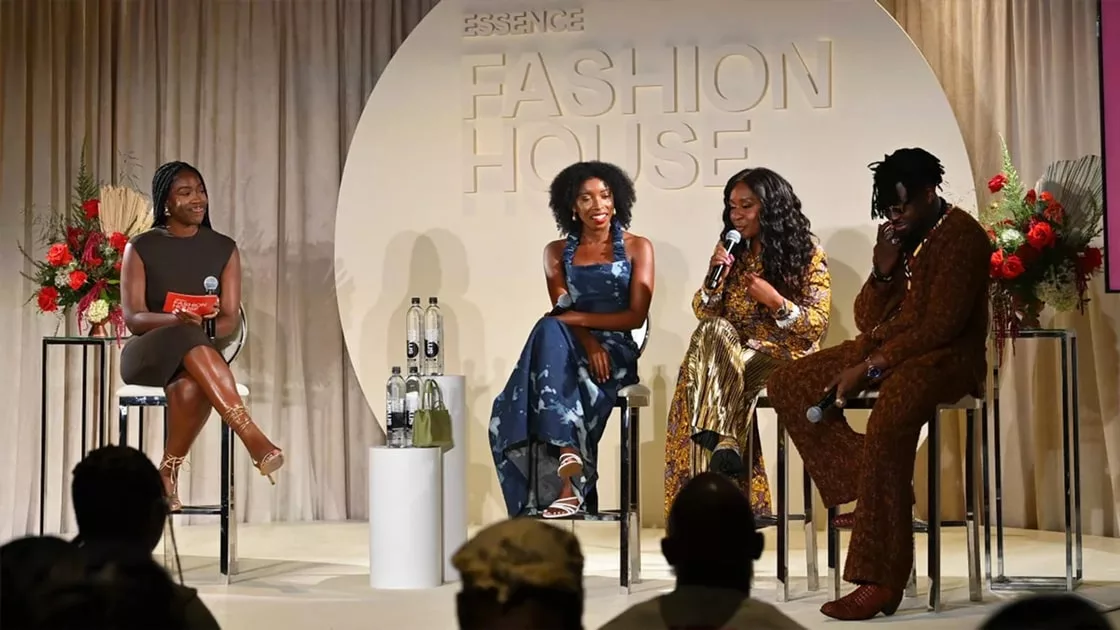
Journalist Nana Agyemang, who is also the CEO of EveryStylishGirl, put together a diverse panel of African designers, industry professionals, and business owners for an ESSENCE Fashion House conversation.
Amira Rasool, the CEO of the wholesale marketplace The Folklore, Barkue Tubman, the Chief of Staff and Diasporic Engagement at Essence Ventures, and Kwaku Bediako, the creator and creative director of the fashion label Chocolate, were all part of the Ecosystem of African Fashion.

They each emphasized the interconnectivity of Africa with the international fashion business during their conversation.

“I feel like it’s so important that we connect,” Tubman said. “That’s part of my responsibility at ESSENCE Ventures, and just really in my life. I think that’s why this all works for me.” “For everything, with each other.
I believe we are aware of our effect on the fashion industry, and connecting the disconnected is what Essence Ventures wants to continue doing.
We’re going to accomplish it via a number of pillars, including economic inclusion, fashion, entertainment, and diaspora. Because I believe that Africa is luxurious, I am a major fan of African luxury.

Bediako emphasized how important it is to link African traditions with those of other continents as well as with those of other civilizations within Africa.
During the discussion, Caroline Wanga, the moderator of We’ve Been Here Before 50 Years of Hip-Hop Fashion, was actually sporting a bespoke Chocolate.
Bright colors and a variety of textures were used throughout the composition.
Rasool is commemorating The Folklore’s fifth anniversary, while Bediako is also marking Chocolate’s tenth anniversary.

Rasool is essential in helping different products gain exposure by securing placements with stores like Nordstrom, Saks, and Bloomingdale’s.

No insult intended, but working with the brands is the most challenging aspect of running our firm, Rasool added. “Because you are creative, your business is sensitive. It’s also the most satisfying aspect, and my journey to South Africa is what actually gave me the idea to found The Folklore.
While I was an undergrad, I had never been there before, and I instantly fell in love with the community.
I’ve worked in the fashion business for some time. I used to work in the media and was familiar with all of the European and American brands, but I was completely ignorant of the South African names at the time.

Content Courtesy of ESSENCE Fashion House & NFH

The Impact of African Fashion, Food and Music on Global Pop Culture

The rich tapestry of African heritage has woven its threads deeply into the fabric of creation in the dynamic world of global pop culture, leaving an imprint that is felt by people all over the world.
The rich symphony of rhythms, colors, styles, and narratives that make up Africa’s effect on the world’s pop culture landscape has captured people’s attention.
African culture has surpassed geographical limits, influencing and enhancing the global cultural mosaic in everything from music and fashion to art and dance.

Music: A Sonic Journey
The throbbing rhythm of African music is at the core of its effect on worldwide pop culture.
Every region of the world has been influenced by pulsating rhythms, contagious melodies, and soul-stirring harmonies that have their roots in Africa.

Traditional African drumming’s rhythmic patterns have evolved into the worldwide sensation known as Afrobeat.

This genre was invented by musicians like Fela Kuti, who combined traditional rhythms with contemporary components to produce a sound that is recognized by audiences on many continents.
Today, the Afrobeat genre has captured the attention of international superstars and continues to influence contemporary music with its mix of funk, jazz, and African rhythms.

Fashion: A Kaleidoscope of Identity
A combination of color, history, and invention make up African fashion.
African textiles are more than just clothing; they are carriers of stories and symbolism, from the dexterous beadwork of Maasai jewelry to the bright designs of West African wax fabrics.

African aesthetics have been embraced by the international fashion industry, exhibiting a variety of design trends and materials.
Traditional African themes are being used as inspiration by designers to create attire that is universal. African headwraps are elegant, kente cloth is regal, and modern silhouettes are combined with indigenous textiles on the runway.

Dance: A Celebration of Life
African rhythms and movements vibrate with vitality in the world of dance. African societies place a great deal of value on traditional dances, which frequently represent rites, holidays, and storytelling.
These dances have developed into a joyful, universal language.

From hip-hop to contemporary dance, the energizing and rhythmic motions have influenced many different types of dance around the world. They demonstrate the ability of dance to span cultures and eliminate language barriers.

Art: A Canvas of Diversity
The range of African art, from prehistoric rock paintings to contemporary works of art, is as diverse as the continent itself. Abstraction, symbolism, and a connection to spirituality are features of traditional African art.
These aesthetic traditions have influenced modern artists and designers by infusing themselves into worldwide pop culture. The impact of African art can be found in graffiti, street art, and modern art galleries around the world.
The blending of classic themes with contemporary platforms speaks to the interaction between the past and present that appeals to people all around the world.

Narratives: A Window into Culture
Through oral traditions, folklore, and storytelling, African narratives have captured hearts for countless centuries. These stories frequently offer illuminating cultural and moral lessons.
African storytelling has recently discovered new outlets in literature, film, and digital media.
For instance, the revival of Afrofuturism imagines alternative worlds while drawing inspiration from African mythology and experiences.
This genre serves as evidence of how African narratives continue to have an impact on and mold the imaginary worlds of popular culture.

Stories that Bind
Imagine yourself captivated by a book that interweaves tales of bravery, resiliency, and interpersonal connections. Whether written by contemporary authors or handed down through the years, African narratives provide a view into a variety of realities.

You’re not simply reading when you immerse yourself in these tales; you’re also connecting to the knowledge of African cultures.
These stories, which are frequently based on oral traditions, serve as a reminder of the ability of storytelling to connect people across time and distance and to weave a rich tapestry of experiences.

It’s not only about adopting a trend when we incorporate African elements into our daily lives; it’s also about appreciating a rich heritage that inspires the way we think, move, and express ourselves.
Africa’s influence serves as a continual reminder that culture serves as a bridge that unites us all, whether it be through the rhythm that makes us dance, the colors that decorate our clothing, or the stories that capture our imagination.

Therefore, keep in mind that you aren’t just adopting a lifestyle when you dance to an Afrobeat song, admire African-inspired clothes, or just embrace the joy of movement. Rather, you are taking part in a worldwide celebration of creativity, harmony, and the beauty of diversity.

Parting Shots; The Unifying Thread
In conclusion, the presence of African influences in popular culture around the world is proof of the ability of culture to bring people together.
Africa’s pulsating rhythms, vivid hues, expressive dances, and intriguing stories have crossed borders and influenced pop culture all over the world.

The resonance of African culture serves as a reminder of the interconnection of humanity and the benefits of accepting diversity.

Let’s recognize the beauty that results when cultures clash, work together, and inspire one another in the worldwide tapestry of innovation as we continue to celebrate the mix of tradition and contemporary.

Content courtesy of  The Guardian Life & NFH

Pamoja Women Organize the First African Cultural Day.

Pamoja Women celebrated African Cultural Day for the first time ever in Rochester.

The co-founders of the group intend to make it an annual event because it was such a success.
The diverse African groups gathered at Rochester’s Peace Plaza for a celebration that was accompanied by food, music, and laughter.

People were greeted by the aroma of traditional African food as soon as they stepped foot in the square.
Six distinct traditional African dances were performed on stage throughout the day.
“Pamoja Women serves these communities, and it’s amazing how that when we needed them, they came through,” said Khadija Ali, a co-founder of Pamoja Women.

The organization works to support and uplift Rochester women and girls of East African descent.
Khadija Ali remarked, “You would see all kinds of ladies who are like, you know, entrepreneurial minds, that actually came today and sold stuff that they did not have the confidence to do at first.
Women and girls in vibrant traditional clothing may be seen all around the plaza as you go around.
Some of them participated in the Sudan fashion show, and one woman even got married.

“We had a wedding ceremony that is known as a ‘jerteg,’ which is kind of peculiar in Sudan. According to Alaa Ali, who organized the Sudan Fashion Show, the bride “wears all red and kind of a gold hat.”

Sudan, Somalia, and Ethiopia had the three largest cultural representations, but Pamoja Women expects that next year there will be even more.
Khadija Ali remarked, “I just hope every year it becomes better and better and better.
Pamoja Women would like to extend their gratitude to the people of Rochester, each of their sponsors, and the various African communities that attended in order to make the event a success.

Content courtesy of ABC 6 News & NFH

To Honor African Fashion and Culture, the Southern African Times Has Opened an Official Merchandise Shop.

In Honor Of African Fashion And Culture, The Southern African Times Opens Official Merch Store
The Southern African Times, a prestigious media company famous for its thorough reporting of news and events, is excited to announce the opening of its official merch store, a representation of African fashion and culture that goes beyond the bounds of conventional journalism.
The recently updated sat store is expected to enthrall audiences everywhere by reflecting the pulse of Africa and building a close relationship with its followers.

The Southern African Times’ executive director of commerce, Edgar Dzimiri, reveals that the store’s resurgence is motivated by factors other than financial success.

Instead, it aims to close the communication gap between media and viewers by creating an immersive environment that reflects the very best of African identity and innovation. “This endeavor extends beyond commerce and product development,” claims Dzimiri.
“Our main goal is to establish a deep connection with our audience.”

The Southern African Times has delved into the world of apparel and merchandise, handpicking a collection that has been meticulously selected. This is a break from the traditional path of media brand expansions.
We’re not working with organizations that are only interested in logo placement, Dzimiri emphasizes.
We are collaborating with committed designers whose carefully produced brands reflect our dedication to authenticity.

African fashion has dominated the global stage in the 21st century, from runways to music videos and movies. Notably, celebrities like Beyoncé and Michelle Obama have appeared on red carpets dressed in African garb, setting trends and igniting interest around the world.
This effect is further amplified by the prevalence of Afrobeat and African dancers on television.. While the world pays attention, young Africans everywhere are showing a rebirth of interest in their history, including a revived passion for traditional clothing and cultural practices.

An example in the field of African fashion, u.mi-1, connects with this story.
They produce contemporary jackets and pants known lovingly as “African denim” by maintaining and reworking the traditional handcrafted Nigerian cloth known as aso-oke.

The designs put a modern spin on tradition while showcasing the depth and variety of Nigerian culture in each piece.

The Southern African Times works with companies like u.mi-1 to promote African design and culture. The media behemoth adds to the ongoing discussion over the value of cultural heritage and artistic expression by opening an official retail store.
By transcending conventional storytelling and enabling readers to embody the precise essence they read about, the convergence of journalism and fashion in the Satstore offers a potent synergy.

The Southern African Times is steadfast in its dedication to engaging with its readers on a deeper level as the worldwide spotlight on African culture becomes brighter by the day.
The official merch store, which invites people to engage with the pulse of Africa and appreciate the richness of African design and culture, is a monument to this commitment.

As the world pays attention, young Africans all around the world have rekindled their interest in their history, including their love of traditional clothing and cultural practices.

Content Courtesy of MENAFN & NFH

Africa’s Fashion Market Will Be Led by Nigeria and Egypt With $2.5 Billion in Sales.

Nigeria and Egypt are laying out their plans to rule the African fashion market, which includes footwear, clothing, and accessories.

By the end of 2023, these two countries are expected to generate a staggering $2.5 billion in revenue.

By 2023, Nairametrics’ analysis of Statista data projects that the Nigerian fashion market would grow to a $1.31 billion industry.

The projected market volume is expected to increase at a strong rate of 10.03% per year (CAGR 2023-2027), reaching an estimated peak of $1.92 billion by 2027.

By 2027, it is anticipated that Nigeria will have a booming user base of about 83.8 million users.
This is projected to increase from a user penetration rate of 24.4% in 2023 to an outstanding 34.1% by 2027.

The average revenue per user (ARPU) is projected to increase to $24.00.

The fashion industry in Egypt is also expected to reach $1.28 billion in 2023, continuing its upward trajectory. This industry is anticipated to reach a market volume of $2.35 billion by 2027, with a compound yearly growth rate (CAGR 2023-2027) increasing at an astounding 16.40%.
By 2027, Egypt is expected to have a user base of 56.4 million in the fashion business. Egypt’s user penetration, which was 33.3% in 2023, is expected to soar to an astonishing 47.1% by 2027.
The anticipated average revenue per user (ARPU) is $34.19.

How Are Nigeria and Egypt Going to Get This Done?
Analysts at Statista claim that the fashion industry has already seen a rise in the worldwide internet revenue share to 23% by 2020.

“The East and Southeast Asian regions are poised to continue driving the global growth trajectory, buoyed by their expanding middle-class population and a lagging offline shopping infrastructure,” according to the report.

Instagram Checkout is an example of an emerging trend that seamlessly incorporates shopping functionality into social media content to facilitate high-speed “inspire and sell” customer conversion.
The audience is gradually moving away from desktop platforms and toward mobile ones, highlighting the growing significance of improving the mobile browsing and checkout experience.

Nigeria is in a unique position with demand exceeding most African countries due to its massive population of over 200 million.
The success of e-commerce fashion is also being propelled by the expanding internet culture among Nigerians, which is being fueled by a remarkable 222.5 million telephone customers estimated in 2022, per the National Bureau of Statistics (NBS).

This shift is being driven by Lagos, which is frequently praised as the center of fashion and design.
With a population that exceeds 100 million and a youthful demographic that includes a sizable portion of people under 30, Egypt also has a sizable population.

This group drives demand in the fashion industry since they are fundamentally more fashion-conscious and eager to spend money on apparel and accessories.
Egypt’s reputation as a top travel destination, which attracts travelers from all over the world, supports the fashion industry further because tourists frequently go shopping and buy local clothing and gifts.

Egypt’s fashion business is boosted by the influx of foreign interest and trade, paving the way for rapid expansion.
As we continue to observe the African fashion landscapes, it appears that Egypt and Nigeria are primed to take the lead in this sector thanks to their sizable populations, thriving internet cultures, and fashion scenes.

Content courtesy of  Nairametric & NFH

Kenyan Fashion Designers Protest Textile Waste With Their Designs

Nairobi’s secondhand clothing market serves as both an inspiration and a backdrop for the fashion industry.
When vendors at Gikomba, the biggest flea market in East Africa, begin setting up their goods on low wooden stalls, dawn has barely begun to paint the sky with a gentle gray tinge.
They carefully organize the secondhand clothing they purchase by weight into enormous sealed plastic bundles by category. a heap of denim.
Tennis shoes stacked high. Bras of all colors and sizes are neatly arranged in a row.
Despite the early hour, throngs of people pack the cramped Kenyan market lanes as vendors shout over one another to promote their wares.

When a trader opens a fresh shipment, the tension increases. Shoppers swarm the area looking for “cameras”. “Items that resemble clothing you would see in a magazine or on television. Isichy Shanicky, a 21-year-old designer at the Maisha by Nisria Collective, said, “That needs to be captured on camera.
She effortlessly maneuvers through Gikomba’s mazes by adhering to its unspoken norms, just like millions of other Kenyans do.

“Arrive early. When a fresh product is opened, you should be present, she advised. “Strip off. The vendor will assess your price by looking at you.
Hold onto a piece you like if you see one. Or someone person will seize your priceless discovery.
Because secondhand shopping is so common, it has its own terminology and manners.

A significant portion of the Kenyan economy is devoted to used clothing imported from overseas. They cost the nation $169 million to import in 2021.
Sixty-five thousand individuals are employed by the Gikomba market alone. The environment and the struggling home textile industry, according to critics, are sacrificed in the process.
At Gikomba, Nicholas Kilonzi began his professional life. Following the passing of his father in 2009, the family was unable to support Kilonzi’s tuition costs.
After landing his first job assisting a dealer in used shoes, he eventually saved enough cash to launch his own company, which presently has three employees.

Kilonzi’s profitability has decreased over time along with the quality of the clothing that is imported from abroad.

We find maybe 10 cameras when we open a 62kg (137lb) package, he claimed. “Five years ago, there would have been 40 or 35.”
The non-camera items, which include cheap, torn, or worn-out clothing, are sold for 50 shillings ($0.35) each.
The leftovers are either turned into commercial rugs or dumped along the banks of the Nairobi River, which flows close to Gikomba.
A third of all clothing is made of plastic garbage, which will degrade into contaminating particles for the earth and the ocean.

One effect of the fast fashion business is the colorful mountains of discarded apparel that line the river’s banks. Such scenes are now commonplace in the Global South, far from the glitzy catwalks and brightly lit storefronts of the world’s fashion capitals.

Nairobi Fashion Week’s creative team planned a photo shoot near the trash to expose the social and environmental crimes of the industry. Its Just Fashion campaign, which runs from April to November, includes the photo session.

“We are not attempting to combat used. It gives millions of people access to affordable apparel and work.
To make fashion sustainable, we support informed consumer decisions and legislative regulations.
Idah Garette, an environmental activist and shot participant, remarked that what people buy has an impact.

Idah is wearing an organic silk dress by Deepa Dosaja, a high-end Kenyan designer who is at the forefront of advocating ethical fashion choices, in marketing photographs. The outfit has hand-painted sustainability slogans.
Dosaja declared, “I have noticed a positive shift. “People who once shopped in Dubai or London now take pride in wearing Kenyan clothing.
Not only is ethical fashion better for the environment.
It generates respectable and worthwhile jobs.
Young designers are already reshaping Kenya’s fashion industry and its long-standing, contentious relationship with discarded clothing.
A new fashion house is called Maisha by Nisria. Its designers, who range in age from 21 to 28, produce unique creations using recycled clothing and leftover textiles.

Shopping at places like Gikomba helps them express their creativity and lessens the negative effects of their industry on the environment.

Conde Tausi, a 28-year-old designer, believes that using secondhand began as a need and later evolved into a goal. “You touch a piece, and it speaks to you,” she says. “I didn’t have the funds to purchase materials when I first experimented with my designs.  leftover clothing from her wardrobe. I eventually realized that the wardrobe was cleaner.
And I pondered whether we would be able to accomplish this on a global basis.

Content courtesy Al Jazeera & NFH 

Pageant Politics: Zozi Tunzi Ditches Miss SA After ‘Dress Drama’

Did Zozi Tunzi ditch the Miss SA pageant finale and unfollow them on IG – after being asked to pay for her own dresses?

There are numerous rumors claiming that former Miss SA Zozi Tunzi skipped the pageant’s grand finale due to an argument about her costume expenses.

Zimoja claimed that Tunzi was required to fit into her attire for the pageant reality TV program Crown Chasers.

The 2019 Miss Universe winner Zozi also appears to have unfollowed the competition on Instagram.

Zozi Failed To Attend Miss Sa
While many former Miss South Africa contestants, including Tamryn Green, Cindy Nel, Tansey Coetzee, and Melinda Bam, were present at the pageant’s conclusion on Sunday, August 13, Zozi Tunzi did not.

The former monarch, who hosted the six-part television series Crown Chasers, had a significant role in the finale’s build-up.

It’s interesting to see that Zozi Tunzi didn’t post anything about Miss SA’s crowning.
Additionally, she stopped following the official Instagram account.

Who Is To Blame For The Dress Dispute?
Zimoja claims that Zozi Tunzi was asked to use Crown Chasers to pay for her wardrobe bills.
That was not covered by our agreement, a person who wished to remain nameless informed the publication. I was hired as a stylist for the show, not by Zozi, and now I’m being expected to bill her.
A five-part television series called Crown Chasers gave viewers a behind-the-scenes peek at the contest.
The show’s hosts were Zozi and the judges were Leandie du Randt and Bonang Matheba.

Reply From Miss SA
Tumi Moema, Zozi Tunzi’s manager, reportedly acknowledged the dress issue to Zimoja.
“Zozi has nothing to do with the stylist’s payment,” he declared. We did not agree to that. I’ll discuss it with them.

The South African contacted Miss SA for a formal response. “Zozibini Tunzi is an in-demand personality with a full schedule,” it was stated in a statement.
Other than that, the Miss South Africa Organization is unable to comment on Ms.
Tunzi’s schedule or her use of social media. At every Miss South Africa event, she is, nevertheless, warmly greeted and recognized.

“The Miss South Africa title carries with it a lot of hope, aspirations and most importantly, it enables young women from all backgrounds to showcase the power of what one can achieve with the right mindset.

“This is a showcase of intelligent, passionate, and confident young women who are carving various paths toward success. The SABC remains the home of events of national importance and our logline for S3 is ‘Open Up’.”

“Crown Chasers” will be broadcast weekly starting from Saturday, July 8, in the lead-up to the final event and the crowning of a new Miss South Africa, which will take place at Sun International’s SunBet Arena at Time Square in Pretoria on Sunday, August 13.

Content courtesy of The South African & NFH


Photographer Meley Sie Celebrates African Culture and Diversity Through Her Lens by Capturing the Essence and Identity

Meley Laetitia Sie is a well-known photographer who has made a name for herself in the fields of fashion and fine art photography.
Meley, a native of Cote D’Ivoire in West Africa, has found her own creative identity and purpose via her lens, revealing the rich tapestry of African ancestry and embracing diversity in her work.
In the revolutionary year of 2020, Meley set off on a voyage to her ancestral home of Cote D’Ivoire, where she reunited with her African history and discovered a passion for creating photographs that honor black brilliance, African culture, and beauty.

This crucial turning point in her life inspired her to build an inspiring network of collaborators, models, like-minded creatives, and brands on Instagram, who all had the same goal of advancing positivity and representation.
Meley began her artistic adventure in her own home, but she has since expanded her wings throughout the American continent, settling in the culturally diverse city of Los Angeles, California.
Her core conviction that her camera has the potential to inspire women of all hues and races is what drives the expansion of her portfolio to include more inclusive models and studio photography.

Meley Sie’s distinctive style of photography goes beyond simply capturing beautiful images to foster a sense of inclusion, empowerment, and belonging. Her camera catches the various hues of beauty found throughout the world, celebrating a diverse spectrum of cultures and races.
Meley uses natural settings, carefully chosen hues, warm tones, and neutral tones to create photos that tell stories that her audience can relate to on a deep level.

Every image, according to Meley, “holds the potential to convey a potent message.” “I want to convey how diverse, powerful, and beautiful our global community is through my work. My medium for promoting inclusivity and change is photography, which is more than just a love of mine.

Meley’s quest for education has also influenced her creative process.
She received her Bachelor of Science in Advertising from the Art Institute of California in San Diego, and then she went on to the New York Film Academy in Los Angeles to receive her Master of Fine Art in Photography.
She has been able to incorporate strategic thought into her visual storytelling thanks to her academic education, which has also improved her artistic vision.

Meley is a popular Instagram aesthetic content developer in addition to her engaging photos.
She promotes her work on her platform and provides insightful advice on skincare, makeup, hair, and photography in addition to sharing her own creative work.
Her interaction with her fans shows how dedicated she is to building a community of people who share the same beliefs in addition to producing art.

The journey of Meley Sie is one of empowerment, exploration, and celebration.
She reveals the layers of identity, beauty, and culture that make up our world with each click of her camera.

Her work serves as an example of the transforming power of art, motivating others to embrace their culture, improve their neighborhoods, and come together via the common language of visual storytelling.

Media Contact
Company Name: Meley Sie
Contact Person: Meley Laetitia Sie
Email: Send Email
Country: United States
Website: www.meleysie.com

Content courtesy of Digital Journal & NFH

Kenyan Fashion: The Independent Zine Honoring Kenyan Designers’ Pulsating Energy

Genuineness does not always entail being responsible or eco-minded, Contrary to popular belief, WAUZINE004, a dynamic digital platform that champions the nexus of fashion, culture, and identity, is on a mission to disprove this.
The pulsating energy of African (note, Kenyan) designers has something significant about the current state of consumer taste, namely the influence of innovative offerings and off-beat aestheticism that brings forth proposals with an avant-garde, distinctive, and vibrant edge.
These designers delve deeply into the fascinating narratives of Kenya’s heritage while blending its relationship with the environments we live in.

The fourth issue of WAUZINE, with the Swahili title KUTOKA NAIROBI (from Nairobi), portrays Nairobi as a city known for its dynamic soul, seamlessly fusing with its rich traditional heritage, transforming into a creative canvas for a plethora of stories that arouse nostalgia and a genuine sense of cultural belonging.

Strong, imposing design: a stunning celebration of both concentration and toil that goes beyond a printed shirt or a suntanned top. It not only represents voices that are both inventive and socially conscious, echoing the pulse of a promising fashion system, but it also perfectly combines tradition, sustainability, and the feverish quest for artistic flare on a worldwide scale.

The fourth edition of the zine, Office describes the work of three Kenyan designers.

Theresia Kyalo
Theresia Kyalo began her career as a lawyer before dipping her toes into the development of distinctive contemporary jewelry. She drew significant influence from antique African jewelry while introducing her aestheticism to the modern day through simple, geometric shapes. Hardy brass is the designer’s material of choice since she wants to keep her line accessible.
A shining moment for the designer came in 2020 when Beyoncé included him on her list of Black creatives. He worked in both digital art and movies.

Yvette Anyango
Designer of Alegohono Yvette Anyango says, “Being featured on the 4th issue of Wauzine has been such an eye-opener for the brand.
It has sparked the urgently required awareness, development, and interest in what African fashion has to offer.
The designer’s collection features a variety of outfits that can be incorporated into a daily wardrobe: neutrals are dominant, and the brand’s guiding principles and ultimate embodiment are drawn from architectural design and include native art and photography.
These straightforward guidelines serve as a design manual for creating clothing with practicality.

Mvoo Wanje
“The history of Kenya is a rich tapestry of customs and civilizations, with an intriguing fusion of African, Western, and Arabic influences. Kenyan culture defies easy categorization; rather, when it comes to artistic endeavors, we have a powerful voice that merits consideration.
Designer Mvoo Wanje of Bonkerz NRB, who established the company in 2011, grew up in the 1990s with little to no media from the continent.
He freely acknowledges the mix of allusions that permeate his clothing “I can say hip hop as a sound and culture heavily influence how I see and create.”

Inspired by the beauty of color and the childlike things in life, the designer cares to share a perspective of Africa that isn’t about the struggle; rather, he’s keen to bring forth energy that translates into utility-heavy pieces that veer towards the functional and the practical with a zingy spirit.

Content courtesy of  Fashion Scouts, Office Magazine & NFH

Ad