Thursday 7th of May 2026

Nairobi, Kenya

African Prints, Jumpsuits And Funk Describe Xuly Bët’s SS21 Paris Fashion Week Show

Malian – Senegalese fashion designer Lamine Badian Kouyaté produced a collection through his brand Xuly Bët that demonstrated resilience and positivity, something that the world and fashion needs at the moment. A collection with African prints but one of multicultural dynamism, and diversity for the Paris week slate of shows is needed more in the City of Lights.

Held at Paris’ l’Aiguillage, an old SNCF train station that has been reconverted into artist residencies and photo studios, held more symbolism than one would imagine. More on that in a moment.

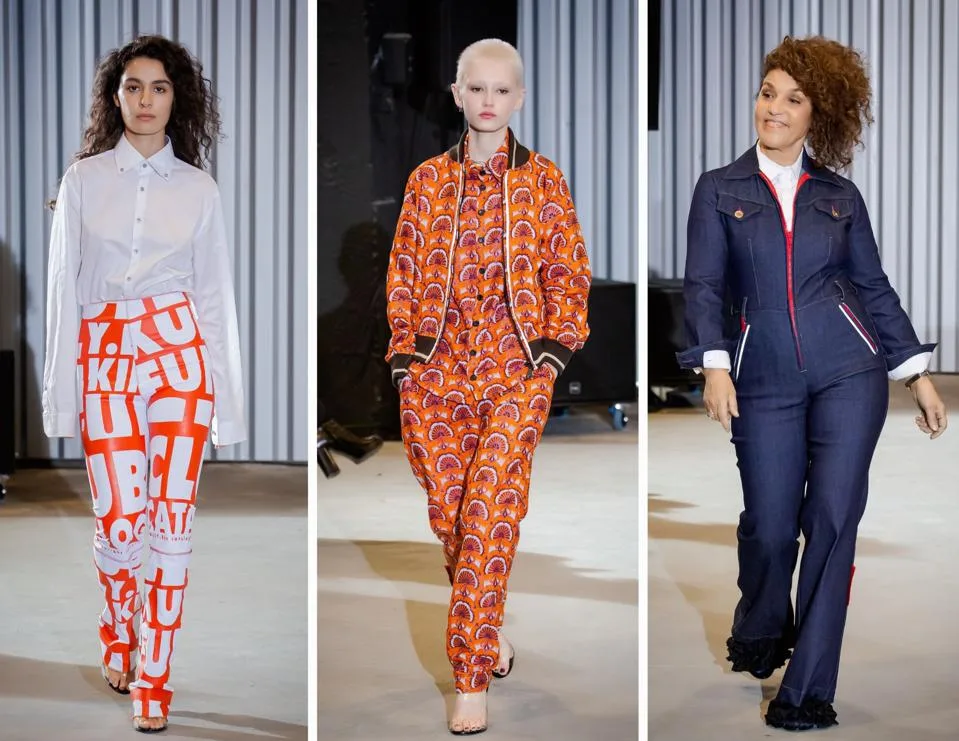
Menswear and womenswear looks ranged from lively African prints on dresses to pants suits. Printed messages across pants can be seen, to gold metallic jumpsuits, to even auto-mechanic inspired blue collared shirts and work jumpsuits.

Casual blazers and pants fill the collection, and shorter hem lines can be found for women’s eveningwear.

It was Xuly Bët’s family and friends that modeled the 44 looks from rapper Kalash, former Miss France Flora Coquere, Brazilian singer Flavia Coelho and comedian Ayoub Layoussifi. The music was handled by Honey Dijon, Neneh Cherry and Robyn.

https://www.instagram.com/p/CGA1mW_AuDt/?utm_source=ig_embed

And the location’s name “aiguilles,” meaning ‘guided’ fits perfectly as 2020 is a year that is guiding humanity into hope amid confusion.

Opening the show with the words of writer and social activist Michaela Angela Davis, Kouyaté and Rodrigo Martinez, the brand’s CEO wanted to honor Davis, as a sort of representation of the times the world is now in. “2020 is not a more difficult year than the others,” writes Davis.

“Times are not harder. It’s just that today, and finally, we open our eyes to society’s dysfunctions, the poverty that always existed, the racial crimes that surround us without ever being mentioned, this colonization that we are paying the price of today. Nevertheless, I remain an eternal optimist. Everything will change.”

Written by Allyson Portee

Content courtesy of Forbes Magazine & Nairobi fashion hub 


Fashion Brand SaS Corner Embraces African Design Through Old-school Hippie Style

Boasting a collection of tops, trousers, dresses and pinafores, SAS Collection looks to the continent of Africa for inspiration for its hippie-style feelgood pieces.

Moved by the vividness of African colours – from the fierce reds of the Maasai culture to  the proud blues and yellows of South Africa’s Southern Ndebele tribe Sara Saleh launched a brand that would embrace its own loud, bold and experimental nature. SAS Corner – which came out July 2020  takes the patterns of Tanzania, Kenya and Zambia, and incorporates them into hippie designs that have been taken straight out of the 1970s.

Using 100% Egyptian cotton, SAS Corner’s collection offers dresses, trousers, pinafores and two-piece sets, all embodying a summer aesthetic, with each pattern named after a different element in Swahili.

“When people dress in bright colours, they get the unique opportunity to translate their soul through the clothes they wear,” Saleh tells #CairoScene. “With our collection, which turns to the vibrancy of colours found across Africa, we’re going for clothes that scream positivity and good vibes, all the while maintaining the comfort and designs inspired by hippie fashion.”

Content courtesy of Cairo Scene & Nairobi fashion hub

LVMH Prize finalist Sindiso Khumalo debuts at Milan Fashion Week with Harriet Tubman-inspired collection

South African designer Sindiso Khumalo made her debut at Milan Fashion Week with a collection based on American abolitionist Harriet Tubman.

With the pandemic keeping many presentations digital, Khumalo’s namesake label presented a fashion film to feature the new collection and honor the life of Tubman, who used the Underground Railroad to free dozens of slaves after reaching her own freedom in Philadelphia. The film shows a model wandering through fields and farmland, hinting at the landscape Tubman might have known as a child.

The collection, “Minty,” titled after Tubman’s childhood nickname, features illustrations by Cape Town artist Shakil Solanki and tailored styles in hand-printed silk taffeta and handwoven cotton from Khumalo’s workshop in Burkina Faso. Khumalo’s brand also works with the NGO Embrace Dignity to employ women who were previously in sex work to hand crochet and embroider garment details.

Khumalo, who earlier this year was one of the joint finalists to share the €300k ($352k) LVMH Prize for Young Fashion Designers, along with London-based Priya Ahluwalia, focuses each of her collections on the life of a historical Black woman.

Her previous collection highlighted the Egbado princess Sarah Forbes Bonetta, who was taken as a prisoner of war as a child and spent many years in the British Royal household under Queen Victoria. Her next collection will be inspired by South African activist Charlotte Maxeke.

“As a Black woman I want to make sure that we’re also part of history,” Khumalo said over a video call. “Harriet Tubman was my height — she was tiny — and freed 70 slaves. I want my kids to know that there were superheroes who were Black and female and petite.”

Having studied architecture at the University of Cape Town, Khumalo worked with lauded architect David Adjaye in London, where she also completed a masters in textiles at Central Saint Martins before returning to establish her label back in South Africa.

We caught up with Khumalo about her collection and presenting her work at Milan Fashion Week for the first time.

CNN Style: What do you want to communicate through your label?

Sindiso Khumalo: I am paying homage to specific Black women from a specific time in history to ensure their stories are told. I can’t believe there are some South Africans who don’t know who Harriet Tubman is. I want to educate people on Black culture and Black history and I think it’s really important that I use my platform to educate, and to bring hope as well. I feel like if I share these stories, people will feel like they can make some change, even if it’s small. It’s important for us to have these role models and talk about them because they are icons of our history.

Another reason I choose these women is to highlight the violence Black women experience, and the violence they experienced in the 1800s. We are still experiencing the same violence today with Uyinene Mrwetyana in South Africa and Breonna Taylor in America — there’s just this violence towards Black women that we have to address.

Why did you choose Harriet Tubman as your inspiration for your Spring-Summer 2021 collection?

In every collection I hint at the next muse. I was studying Sarah Forbes Bonetta and Harriet came through in some of the research I was doing. I embroidered Harriet on one of the dresses from Autumn-Winter. For Harriet actually there’s a lot more work to be done so I think she will have two collections.

I don’t look for the muse, it feels like we find each other in the process. The muse will always be a female and she will always be Black and she’ll always be from a specific time in history.

There are so many women who haven’t had their story told Bonetta had the most extraordinary life, and when I was telling people about her, no one knew who she was.

What are some of the details in the collection that relate to Tubman’s life?

One of the first details is that we worked with this artist Shakil Solanki on making hand-printed designs of cotton plants. I wanted to imagine Harriet in her Sunday best, but she’s six years old  my son is six picking cotton on a plantation in the sun. I wanted to portray the darkness in a very compelling way so I asked Shakil to paint the most beautiful cotton plant he could make. These plantations were beautiful with lovely homes and well-dressed women. But (the designs) are also a reminder that this is the plant that a six-year-old girl was picking. It’s a beautiful plant but it has a very dark history.

Sometimes when we talk about slavery, we abstract things so much that you don’t actually understand the human story there. I’m a mum  the idea of a child picking cotton is just repulsive to me. It’s not just slavery, but the human story within that.

The other way I brought her into the collection is through her name. Philadelphia was such a crucial part of her life, and when she was there she named herself Harriet after her mother. She was born Araminta, Minty for short. But on the garments it’s Harriet because that’s what she named herself. We included the Philadelphia Fleabane, which was the first wildflower she would have seen crossing into freedom.

Did you find that the limitations of this year’s Fashion Week allowed for more creative expression?

We’ve never made a fashion film before. We’ve never had a reason to. It’s a very different thing from the stills. Strangely there’s a small town called Philadelphia outside of Cape Town, and Philadelphia was the borderline where Harriet stepped into her freedom, so we wanted to tell that story.

I don’t think I could have made the same statement in a (runway) show. And that I think is the joy of everything slowing down everyone has had to sit and watch and engage. Fashion week is a flurry everyone’s going from show to show to show and you’re just hoping somebody sees your stuff. Maybe from now on we’ll always have a film to go with the collection because it’s a way for people to really go deeper and understand our message.

Tell me more about the NGO you partnered with for this collection.

I’ve been working with Embrace Dignity for a few months now. They work with women in Cape Town who are former sex workers and place them with work that is safe and non-exploitative.

We actually train these women up in our studio in crochet and hand embroidery. For me, it’s also about imparting a skill that they can also use themselves because in Cape Town we have a tourist market. It’s a combination of giving them a safe place to work, a non-judgemental place, and then also giving them a skill that they can then use. Everybody needs the chance at a second chapter we have so much poverty in South Africa.

I like to think of myself as a bit of a modern-day Robin Hood. I sell these luxury clothes and then try to make some kind of change within a community. I think people get overwhelmed and they feel like they can’t change anything, but I look at icons like Harriet Tubman and Nelson Mandela and I think you can make a change. You have to do something, even if it’s small.

Content Courtesy of CNN & Nairobi fashion hub

Telfar Clemens Wins National Design Award for Fashion Design From Cooper Hewitt

This is the second significant award Telfar Clemens has won recently, having been honored with the CFDA’s Accessories Designer of the Year award last month.

The Cooper Hewitt, Smithsonian Design Museum planned a virtual gala for Thursday night’s 21st National Design Awards.

Instead of welcoming hundreds to the Upper East Side museum for its annual awards gala, the Cooper Hewitt took a more remote approach for the event, which doubled as a kickoff for National Design Month. To promote an all-are-welcome theme, footage of the gala and ancillary educational programs are available online at no charge for anyone to discover the importance of design.

The Fashion Design award went to Telfar, but the company’s founder Telfar Clemens was not doing any interviews at this time, according to a Cooper Hewitt spokeswoman. An interview request sent to his company was not acknowledged.

In a self-description included in the Cooper Hewitt’s press material, Clemens wrote, “Become a queer, Black 18-year-old, travel back to 2004 and establish a 100 percent nongendered fashion line out of your family apartment in LeFrak City, Queens. Make clothes that do not exist on (folo) the market  just like you don’t exist in the world. Don’t have any money. Persist for a decade without a single review from the fashion press. Do everything differently. If stores won’t buy your clothes, show in museums.

If ‘beauty’ sponsors don’t like your skin and hair make the uniforms for a fast-food chain. Use the money to help bail out hundreds of kids off Rikers Island. Win the CFDA/Vogue Fashion Fund, use the money to make an ‘It’ bag, where ‘It’ has nothing to do with domination. Refuse to be tokenized. Decline invitations. Use ‘fashion’ to envision a future that can help destroy the present. Lots of love, keep your family close, breathe; ignore the bulls–t, and please remember: the world isn’t everything.”

Clemens recently won another award of great distinction the 2020 Accessories Designer of the Year award at the CFDA Awards last month. The in-demand designer, who designed uniforms for 400-plus White Castle workers, unveiled a collaboration with Ugg a few weeks ago.

Studio 189 picked up the NDA’s Emerging Designer award. Founded by Rosario Dawson and Abrima Erwiah, the label is an artisan produced lifestyle brand and social enterprise. Made in Africa, Studio 189 produces African and African-inspired content and clothing.

The Cooper Hewitt gave the Communication Design award to Scott Dadich, the founder of Godfrey Dadich Partners and creator of the Netflix series “Abstract: The Art of Design.” The Digital Design award went to Design I/O. Kickstarter, the crowdsourced launcher of many design-minded products and concepts, was the recipient of the 2020 Design Visionary award.

The NDA for Product Design was won by Catapult Design. The Oslo-based Snøhetta locked up the Architecture award while Sponge Park, located along the Gowanus Canal and designed by DLAND studio, earned the Climate Action award and OJB Landscape Architecture was the Landscape Architecture winner.

Content courtesy of WWD & Nairobi fashion hub 

Nisha Kanabar The Curator Championing African Fashion

Nisha Kanabar knows a thing or two about global fashion. Kanabar grew up in Tanzania in a family of Indian origin, moved to the U.S. to study at Parsons, and has worked at American Vogue, Vogue India, and Style.com in the Middle East. In 2018, her expertise led her to launch Industrie Africa, a platform representing the diversity of contemporary fashion in Africa.

She founded Industrie Africa in hopes of addressing the misconceptions and stereotypical impressions of what African design really is. “It was important for me to create a 360-degree hub of contemporary African fashion that’s global, curated, and current,” she told the Cut. “A space of commerce, content, and community celebrating and representing the voices of the industry and its pioneers.” The site is both a directory and a store, with over 80 brands from 24 different African countries.

The Cut spoke with Kanabar about The Real Housewives, French fries, and those Balenciagas that look like socks.

What’s one part of your work that’s especially meaningful to you?
Our inaugural summer campaign! It’s true to who we are as a platform and the designers we represent: fashion focused and curated, yet diverse and dynamic. The clothes and styling are powerful, distinct, and intrinsically African.

How do you thank someone for a gift?
A note of thanks via eye-catching stationery and  more importantly a reciprocal gesture of appreciation. That mutual exchange of generosity and thoughtfulness goes a long way in cultivating relationships.

What would you never wear?
Non-stretch skinny jeans. Make them low rise and then you have the stuff of nightmares.

What’s your dream vacation?
A long, ambling culinary journey across the Far East, peppered with street food and special restaurant experiences. Currently, Tokyo and Kyoto are at the top of my list. Beyond food, Japan has the most incredibly fascinating city cultures.

What’s a good book on your coffee table right now?
Not African Enough, by Sunny Dolat. Sunny is an exceptional ambassador for the shifting aesthetics of African (and, more specifically, Kenyan) fashion, often provoking dialogue on this notion of what is “authentically African.” He also sits on Industrie Africa’s advisory board.

Last show you binge-watched?
Masaba Masaba on Netflix.

What’s your guilty pleasure?
Real Housewives of literally anywhere.

Secret to hosting a good party?
A good atmosphere stems from great lighting, delicious drink, and a very attentive host.

What is a trend that you like right now?
Considered, conscious shopping habits. The consumer of today is different from the consumer of six months ago people value “slow fashion” and search for meaning in their purchases more than ever.

One you don’t understand?
Corsets. I like to breathe.

Favorite restaurant in New York?
Gramercy Tavern, my neighborhood haunt back in the day.

What’s the one thing you could eat every day for the rest of your life?
Crispy, chile-lime-salted French fries!

Shoes you wear most often?
Day to day, mostly leather sandals for our coastal tropical climes. When I travel? Probably my Balenciaga knit-sock sneakers.

What are five inanimate objects that bring you joy?

Ami Doshi Shah Form Earrings $285

Buy Here

“You will not find anything like these geometrically sculpted brass earrings. They walk a delicate line between sophistication and edge. All Ami’s pieces are inspired by her Kenyan environment, handcrafted using local materials.”

Fornasetti Rossetti Scented Candle $365

Buy Here

“Fornasetti ceramics are the ultimate whimsical indulgence. Their candles (housed in decorated heirloom vessels) take on the role of art and accessory and add great texture to your home.”

Lisa Folawiyo Wide Leg Pants $420

Buy Here 

“I love to build a look around one statement separate, and these luxurious, mixed-print pants from celeb-favorite Nigerian designer Lisa Folawiyo are both fun and fashionable.”

Patrick Mavros Mongoose & Cobra Swizzle Stick $366

Buy Here

“Zimbabwean heritage brand Patrick Mavros has been creating these masterful, wildlife-inspired silver accessories since 1980 (you can shop their jewelry on Industrie Africa). I love these darling sterling-silver swizzle sticks; they complement any bar set, make a great gift, and are a lovely conversation piece.”

Okapi Black Stonewash Aja Clutch With Black Ostrich Feather Charm $670

Buy Here 

“These ostrich-skin leather clutches are breathtaking and meticulously crafted, and they come paired with playful accessories like this feather charm. They’re also guilt free (the brand has adopted a no-waste ethos and uses materials that are ethically sourced as a by-product of South Africa’s preexisting farming industry).”

Content courtesy of The Cut & Nairobi fashion hub 

Milan Fashion Week gives small opening to Black Lives Matter

MILAN (AP) – When asked why there aren’t more people of color in the Italian fashion industry, officials have cited a lack of candidates in homogeneous Italy. Five African-born designers in Italy want to put that view to rest with their inclusion on the official Milan Fashion Week calendar Sunday.

Fabiola Manirakiza came to Italy after her parents were killed in her native Burundi in 1972. For her Made-in-Italy Kiza label, she incorporates patterns from her Bantu tribe, as taught by an elder sister, into her Western tailored silhouette, the influence of the Italian family who raised her.

‘’It is not just Italy that needs to see, it is the whole world,’’ said Manikrazia, whose creations were among those featured in the video presentation titled “We Are Made in Italy. Italy is Made of Us.”

The official Black Lives Matter in Italian fashion event is a first step in a process that Stella Jean, the only Black designer belonging to Italy’s prestigious fashion council, hopes will bring real diversity to the creative and decision-making centers of Italian fashion to combat racism in the industry.

Another critical step was the launch of a think tank last week bringing together top fashion houses on the council with Black creatives. But Jean said there remains resistance to the campaign she has launched with U.S. designer Edward Buchanan and Michelle Ngomo, founder of Afro Fashion Week Milano, with pressure on them to abandon it.

Italy’s relatively small African-origin population, which government statistics put at around 1.2 million, has rendered it mostly invisible in the country of some 60 million, with no well-known faces in the political class or on television — and few behind the closed doors of Italian fashion.

Jean and her colleagues began pushing the industry to make concrete moves toward diversifying Italian fashion after major houses showed social media support for the Black Lives Matter protests over racial equality and police brutality during the summer. After many racially charged gaffes in recent years, they also are asking for an accounting of the numbers of people of color working inside the system.

“No one is looking to stand back and blame you for the current situation,’’ Jean said in introductory remarks to the think tank, made available to The Associated Press. ‘’Instead we are asking you to be part of the solution starting today. Racism in Italy … is a very unique case study. It doesn’t resemble the type that exists with our European neighbors and it also differs greatly from the American kind. This however doesn’t render it less harmful or discriminative, only different.’’

Jean told The Associated Press that the few companies whose representatives spoke discussed activities to support Black minorities in the United States and other causes ‘’but completely avoiding the point of our discussion: Black minority in Italy.’’

“I must say with all sincerity that the silence of the representatives of the colossal Made-in-Italy brands left a lasting bitter and embarrassing impression,’’ Jean said. ‘’In total astonishment, it struck me that greatness and global commercial authority does not always correspond to an equally grand sense of responsibility to humanity.’’

On a positive note, the fashion council had agreed to implement six reform points by February, she said. The council also agreed to provide scholarships and mentorships to fashion students of color. And she hopes that the time spent listening will lead to greater participation next time.

The head of Italy’s fashion council, Carlo Capasa, called the meeting ‘’interesting and instructive,’’ and that the brand representatives were there to mostly listen. ‘’There was no reason for friction,” he said.

Calling the meeting, ‘’a beginning,’’ he told the AP the council will continue to work on diversity points of its nearly year-old diversity manifesto, including the commitment that diversity is an asset. He confirmed that the think tank would continue to meet periodically.

The brands participating were Armani, Zegna, Bottega Veneta, Etro, Gucci, Prada, Valentino and Ferragamo. The Kering conglomerate, which owns Gucci and Bottega Veneta, and the OTB group, which owns Marni and Diesel also participated.

A planned closing statement was never issued.

But Miuccia Prada, during the video presentation of next spring’s collection, emphasized the importance of inclusivity, along with sustainability. She acknowledged the need to ‘’really embrace it,” adding ‘’which is what I decided to do, not only declaring it, but trying, little by little, to be better.”

The participants in the Black Lives Matter event have worked in other trades or professions before following their fashion dreams. Most have submitted resumes to fashion companies, with no response, and some have seen professional doors fail to open after promising meetings, without explanation.

Joy Meribe, born in Nigeria and with an Italian Masters in business, studied fashion in Italy so she could alter garments she was selling through her blog on African fashion designers, and realized she had the knack herself. Her collection, Modaf Designs, uses African prints on silk and cotton instead of the traditional wax cloth, making them easier to wear and integrate into a Western wardrobe.

Claudia Gisele Ntsama, originally from Cameroon, has supported herself cleaning houses to pursue her dream of becoming a fashion designer, unveiling in Milan fantastical swirling pieces made mostly of raw hemp.

Ngomo, who discovered the five designers, said she feels a great responsibility also to young people of color in Italy who have been inspired by the initiatives.

‘’Many kids are writing to thank me, saying they have rediscovered their trust, and they had hope,’’ Ngomo said. “I know we are trendy now. I am not sure next year we will have all this light on the project. I want to be positive and believe this is a next step.’’

Content courtesy of Journal Now, The Associated Press & Nairobi fashion hub

Caribbean Designers Make Modern Looks From Traditional African Prints

Photo by David I Muir Model: Michelle McLean

Fashion isn’t for decoration only. What we wear can be a proud declaration of our cultural heritage. This is the guiding principle for these Caribbean fashion designers, who are using African-inspired prints to create styles that fit every woman. Inspired by their culturally grounded, but always fashion-forward perspective, we take their stunning looks out for a stroll.

Photo by David I Muir Model: Michelle McLean

Designed by Fashion brand Brass and Sassy, this dark, striped romper feels fit for the daring diva, combining a bare midriff with butterfly sleeves with layered pum pum shorts. Add a pair of dark strappy heels and prepare to have all eyes on you.

Photo by David I Muir Model: Maisie McNaught

Also from Brass and Sassy, this matching tied bandeau top and fitted, flared pants in earthy hues of orange, green and deep red create a statuesque silhouette.

Photo by David I Muir Model: Maisie McNaught

Bright orange with bands of purple are made fit for a queen in this regal, billowing off-the-shoulder dress designed by Kulture Klothes, a chic boutique in Miami Gardens. With a floor-length hemline, it’ll make you look like you’re walking on air.

This off-the-shoulder denim number from Kulture Klothes is dressed up with large flower patterns, accent bands of fabric, and a whole lot of bling. Casual, eye-catching, fabulous.

Photo by David I Muir Model: Kimberley McNaught

From Kulture Klothes, this sleeveless, high-low baby doll dress is fitted at the top with a shapely lower half that’s short in the front and long in the back. The blue and red fabric is accessorized with royal blue shawl and head wrap.

Model: Michelle McLean
Model: Maisie McNaught
Model: Kimberley McNaught
Makeup: Faith Elibert

Content courtesy of Island Origins Magazine & Nairobi fashion hub 

Elijah Mcquinn The boldest fashion brand in Uganda

Hello I am Harriet and I will be your personal designer today. I love to help you to design and buy African print clothing that perfectly suits your personality and style.

International clothing brands are hard to get by in in the Ugandan capital of Uganda. That does not mean that the urban hipsters are left behind. A surge of young ground breaking designers has taken over the market of Ugandan fashion landscape and now determines what is trendy.
We talk to Harriet Alur who is the creative director of Elijah Mcquinn, a sustainable fashion brand located in Kisementi, next to Brood.

Harriet, Where does the name and brand Elijah Mcquinn originate from?

Elijah Mcquinn is my son`s name. His coming to the world inspired me to start a clothing line that would support both of us.

Since those difficult early days as a single mom I am now proud to announce the opening of our first shop in Kisementi. It offers both posh dresses, skirts & tops with kitenge features as well as cool streetwear & shorts with an African touch for men.

Where do you get your inspiration?
Our inspiration comes from frequent visits to the country`s largest market `Owino` (meaning born with a cord around the neck). While getting lost in the chaos and commotion of the people both buying and selling used clothing and cooling down later in the day in the most fancy upmarket boutiques we are able to obtain unique insights which allow us to redesign in all creativity.

Your brand Elijah Mcquinn claims to be sustainable. Can you explain?
Every day tons of second hand clothing are dumped onto the African continent. For every piece of item dumped, a local tailor has one day less income. As Elijah Mcquinn we decided to make a statement against this unsustainable practice by recycling the attributes of this original western clothing.

How would you describe your style?
We want our clients to feel in a fairytale destination where the sun always shines. We mix, blend and merge styles from across the 4 wind directions and regions in Uganda . This allows us to impress both upmarket Ugandan clients as well as foreign visitors.

Our jumpsuits draw all attention to you during that fancy cocktail party in Kololo. Our chiffon maxi dresses will convert an early spring day into a full summer in Paris. Our silk kimonos will reveal an oriental touch in . Our bomber jackets make your street style pop in the streets of New York

Recently you added a travel bag line.
Our clients requested us to reflect on their regular travel needs as they indicated the absence of fashionable bags to carry. Therefore we developed crafted work of the best leather available in combination with animal skins. Our safari travel bags make you stand out in even the most upmarket hotel lobby.

https://www.instagram.com/p/B4E0uCdFXXY/?utm_source=ig_embed

Would you say that beauty can be purchased or it is intrinsic to a person?
We believe that every lady has what it takes to be beautiful. It is all about developing your own style and highlighting your strongest features. We are glad to explore with our clients how our designs an attributes can do that perfectly. To help ladies show their beauty even further we recently offer organic shea butter directly from Northern Uganda to revitalize and smoothen our delicate skins.

What message do you have to share with the audience?
Be proud of your Ugandans origins without being feeling shy to recombining your style with other foreign themes. In Uganda people tend to think that foreign products are automatically of superior quality.

Unfortunately that is how we have taken advantage of and mediocre imports enter the country under the flag of international quality. With my brand I want to prove that `Made in Uganda` can reach international standards and has what it takes to make us all proud.

We select buttons, laces, linings and cutouts which are still in perfect condition and we reuse them into newly designed items. This reduces local clothing market distortion and reduces the environmental impact by unnecessary production. We try to send these up-cycled articles back to Europe for retail to the same people who threw them. I wish they knew.

Where can we find you?
We are located on plot 4 sturrock road, Kisementi, Kampala. Right next to Cutting Station Kampala. S
Since last summer we also occasionally during popups in Antwerp in Belgium.

Online sales are done at www.elijah-mcquinn.com
www.uganda-fashion.com
More designs are available on our Instagram page @elijahmcquinn

https://www.instagram.com/tv/CEeKcI9nG5g/?utm_source=ig_embed

Content courtesy of Elijah Mcquinn & Nairobi fashion hub

5th Glitz Ghana Women Of The Year Honours awards 2020

Glitz Africa has awarded some 11 women and the Ghana Health Service in the 5th edition of it’s Ghana Women Of The Year Honours.

The award recognizes women in various industries who use their position, expertise, and influence to inspire others to make a difference while empowering other women.

Recipients of this year’s honours were selected by a competent board of achievers who used objective criteria to determine the list of deserving women in different fields.

The Gala came off at the Mövenpick Ambassador Hotel in Accra at 7 pm on Saturday, September 25, 2020.

The event which was hosted bilingual broadcaster, Anita Erskine was streamed live on Glitz Africa YouTube channel and on partner media station.

https://www.instagram.com/glitzafrica.hq/?utm_source=ig_embed

Performers who thrilled attendees were at the ceremony were young poet Nakeeyat Sam Dramani, musicians Akwaboah, Efya and MOG.

This year’s event featured a campaign which promotes sexual consent running with the hashtags: #ISaidNo #NoConsentNoSex . This was promoted with influencers to sensitise the public about the effects of rape in the society.

Below are receivers of the 5th annual Ghana Women of the Year Honours :

Frema Osei-Opare –  Governance

Elsie Addo Awadzi – Corporate Personality

Prof. Rita Akosua Dickson – Excellence in Education

Dr. Afua Asabea Asare – Excellence in Public Service

Beatrice Agyemang – Excellence in Media

Rev. Dr. Gifty Akushika Lamptey – Excellence in Business

Ethel Delali Cofie – Excellence in Technology

Nana Ama McBrown – Excellence in Creative Arts

Berla Addardey – Young Star

Judge Prof. Akua Kuenyehia – Lifetime Achievement

Bozoma Saint John – Woman of the Year Diaspora

Ghana Health Service –  Honourary Recognition

Special Guests of Honour at the event were Konadu Agyeman Rawlings and Gender Minister, Cynthia Mamle Morrison and media personality and talent manager Frema Adunyame.

Glitz Africa is a high-end celebrity, lifestyle and fashion brand which puts the spotlight on the life of contemporary Africa in their quarterly magazines.

They are known for organising shows such as Ghana Women of the Year Honours  Glitz Style Awards which celebrates African creativity and style and Glitz Africa Fashion Week to provide a platform for established and upcoming fashion designers to showcase their works to an international audience.

Content courtesy of My Joy Online & Nairobi fashion hub

Issa Rae Is Now the Co-Owner and Face of Sienna Naturals

To re-launch a brand with bigger and better products is one thing. But to return to the game with improved offerings and a big celebrity name is a feat very few beauty brands can brag about, especially when the said celebrity is none other than Issa Rae.

HBO’s hit show Insecure is known for its beautiful display of natural hairstyles thanks to creator and star Issa Rae. This week, the filmmaker announced she is now the co-owner and face of Sienna Naturals, a brand of natural hair care brand with clean ingredients.

Rae will join the team with founder and CEO Hannah Diop to work on expanding the collection and its customer base.

“I’ve known Hannah for a long time, and I got to see the brand evolve from her home. It’s expanded so much beyond that. The care and the research that has gone into this natural, safe, healthy brand, I knew that I wanted to be involved,” Rae said in a statement according to The Cut.

“We get coerced into manipulating our hair into styles not right for us or using damaging products,” Rae continued. “I have an opportunity to make hair care digestible via my sense of humor, my openness to my own hair struggle journey.”

Diop says she was happy to work with Rae and praised how she used Insecure to showcase the versatile beauty of Black hair.

https://www.instagram.com/p/B7m6W5DAknr/?utm_source=ig_embed

“Sienna Naturals is not a company that is telling you how to wear your hair,” said Diop. “We believe in empowering our customers to be who they really are and have a product that supports them.”

Customers can add themselves to the waiting list to learn when the products will become available.

Content courtesy of Black Enterprise & Nairobi fashion hub

Lizzo On The Cover Of ‘vogue’ Magazine October Issue

Vogue released its October 2020 cover on Thursday, and it’s Good as Hell: The always fabulous Lizzo fronts the issue, which was shot by Hype Williams and styled by Carlos Nazario.

She Can Be Heroes “I had to travel the world and I had to meet people and read DMs and look into their eyes and really hear their stories, to believe that I was making an impact in a positive way,” says Lizzo. Moschino Couture cape. Sylva & Cie earrings. Bvlgari necklaces. Bracelets and rings by Tiffany & Co. and Chopard. Photographed by Hype Williams, Vogue, October 2020

Clad in a crimson Valentino dress that a politician could probably pull off at a luncheon, the ensemble is rather toned for the performer. (We’re used to seeing the artist in head-to-ruffles and over-the-top feathers, after all.) But the glam is turned up in the accompanying editorial, as Lizzo wears everything from a princess-worthy bubblegum pink Moschino Couture gown to a beaded LaQuan Smith top and skirt.

In the cover story, Lizzo talks justice and the upcoming election with Claudia Rankine. “I just want to encourage people to register to vote,” the bop singer said. “That is the most important thing to me. Because there’s a lot of upset people, and there’s a lot of people who have power. There’s a lot of voter suppression in Black communities. But there’s a lot of angry white kids now. And I’m like, ‘Yo, register to vote. Go out. You won’t get suppressed if you try to go to your ballot box.’

The self-love queen  who Vogue recently announced will be speaking at its Forces of Fashion conference in November also touched on the importance of maintaining a public image that is committed to positivity and celebrating her uniqueness.

“I think it’s important that I take full responsibility for the way the world perceives me because that is the way they’re gonna perceive someone who looks like me in the future,” Lizzo explained. “Maybe, hopefully, that would give some young girl someone to look up to and take away the opportunity for someone to weaponize her uniqueness against her. I had to travel the world and I had to meet people and read DMs and look into their eyes and really hear their stories to believe that I was making an impact in a positive way. And now that I believe in myself in that way, I’m gonna continue to just push that conversation by being a better me every single day.”

The October issue of Vogue will be available on newsstands on Oct. 6. You can read Lizzo’s full cover story here.

Content courtesy of Fashionista, Vogue & Nairobi fashion hub 

African Prom Dresses

Are you looking African prom dress ideas to inspire you for the big night? Or simply looking for the best African prom dress stores online. Hurray! You’ve come to the right place!

Find the latest 2020 dashiki prom dress styles Find your perfect modern & trendy African print prom dress and gown for you.

Prom is one of the many exciting highlights of every high school girl. It’s one of those events in your life that you want to stand out beautifully & effortlessly from the crowd! Over the years, prom has and always will be a big deal for most high schoolers especially in America.

No one ever forgets what they wore on this big night. Which brings us to African prom dresses! They entirely steal the show if you ask me. They draw an accurate picture of what the black lady represents. Bold. Beautiful & Breath-taking.

Every day, we are inundated with latest African dress styles and top dashiki prom dresses. While Africa might not be the first idea that comes to mind for most people when it comes to new fashion trends, African print dresses, or dashiki dress as it’s better known proves to be a great option for a variety of occasions & moments.

Each year, African fashion designers come up with fresh, trendy & stunning African dresses that are excellent choices for all occasions ranging from prom date, weddings, ballroom and gala nights and everything in between.

African dresses are known for their vibrant mixed colors. It’s one of the qualities that makes the African print fabric a versatile and sensational option for special moments like proms and weddings.

The color and shine that accompanies African print prom dresses are irresistible. Let’s not forget that every dress needs accessories to go with it. African print dresses are the easiest to accessorize. This is because of the variety of colors you can choose from. If for example, you were going to wear a white dress, this would limit your accessory options tremendously. On the other hand, if you chose an African print prom dress with three mixed colors, then that increases your options.

African dresses can fit into any customization you find best. Furthermore, they come in multiple colors. The designs of African prom dresses also offer a more natural look. Some clothes can be used to tie your hair up into a neat look to compliment the dress. The cloth is often the same theme and color as the dress to give you that very natural look.

No matter how much we talk about African prom dress designs, it won’t help if you don’t know where to buy prom dresses for black girls. Note that some designs are often done using low-quality cloth, so be careful with where you choose to buy your prom dress.

Each dashiki dress is custom made for you. To help you find the best African prom dress, we have curated 100+ dashiki prom dresses and styles for your big night. So, don’t be afraid to step out beautifully in one of these beautiful African print prom dresses. You are sure to make lots of heads turn in amazement and receive tons of compliments.

And don’t forget, or the look to be perfect, it is usually advisable to liaise with your hair stylist, so you get the perfect hairstyle to complement the dress. African print prom dresses can be woven into a lot of shapes and sizes. So, it doesn’t matter how you look, there is a design that would look absolutely gorgeous on you.

Content courtesy of Africa Blooms & Nairobi fashion hub 

Ad